TL;DR
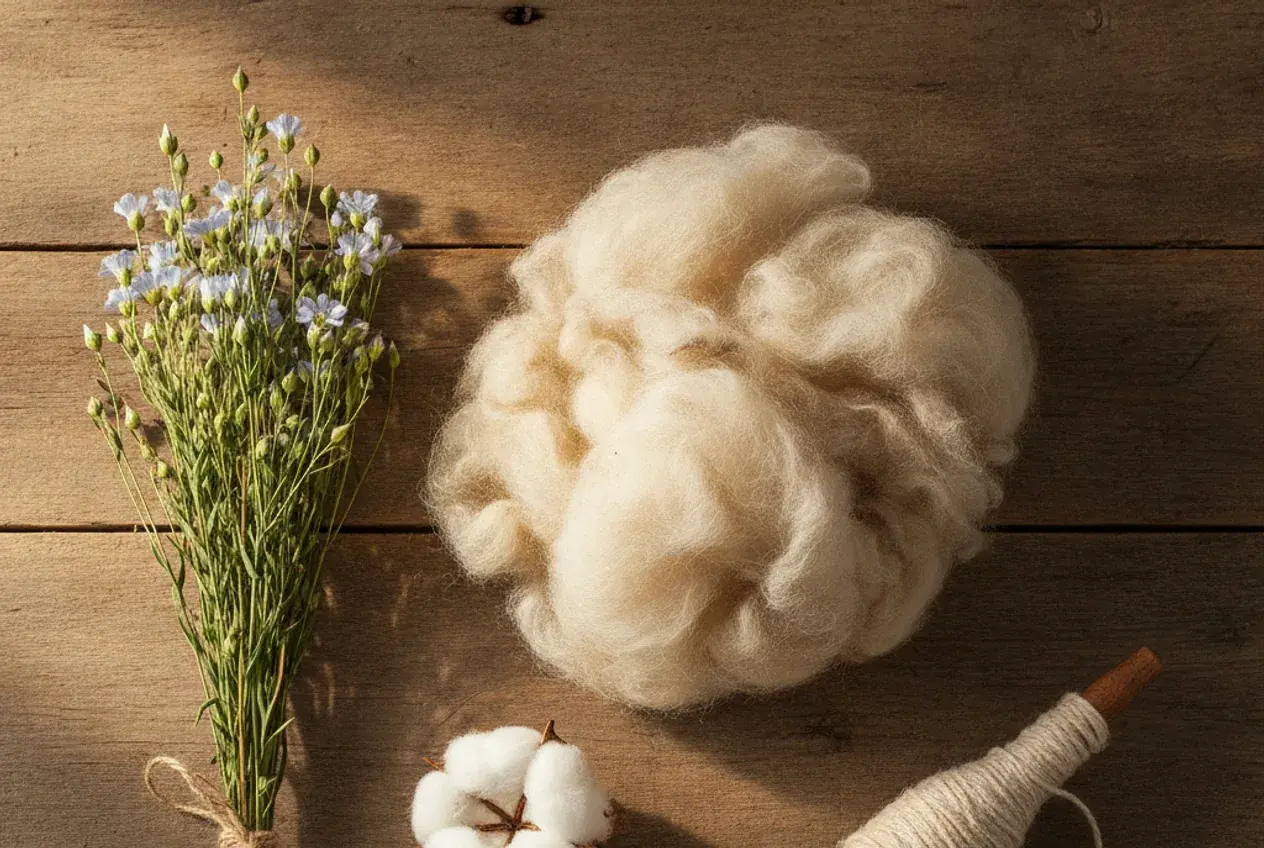
Cotton will not grow outdoors in Germany: it needs 180 to 210 frost-free days at a sustained 21 to 30 degrees Celsius, and no German summer delivers that reliably. Flax, on the other hand, was Germany's standard fiber crop until the 1950s and has seen a small revival since the 1980s, including the nationwide 1qm Lein project. Growing hemp for fiber is legal only for registered farmers according to the German Hemp Association, not for private individuals, regardless of how low the THC content is. Wool needs no cultivation at all: many shepherds give away raw wool from older breeds for free, since the market price of 30 to 80 cents per kilo barely covers the cost of shearing.
A T-shirt grown from your own cotton sounds like the ultimate self-sufficiency project. In Germany, it fails on the weather before anything else.
Anyone who wants to make clothing from plant to finished garment quickly ends up looking at other fibers instead: linen from flax, which was the textile backbone here for centuries, and wool, which does not even require a plot of land. Hemp belongs on that list too, fiber-wise, but with a legal restriction that surprises most beginners.
This article walks through which fiber actually grows in a German garden, what cultivation and processing really involve, and what an honest path from field to finished garment looks like. For how a project like this fits into a broader self-sufficiency plan, see our honest 12-month plan.
Why cotton does not work in a German garden
Cotton (Gossypium) is one of the most heat-demanding crops there is. Agricultural sources such as the growing guide Wikifarmer put the minimum at 180 to 210 frost-free days, combined with sustained temperatures between 21 and 30 degrees Celsius through the entire active growth phase. Once the temperature stays below 20 degrees, the plant's growth stalls.
That sounds at first like a simple matter of day count, and Germany has actually gained days there. According to an analysis by the Federal Environment Agency (Umweltbundesamt), the growing season has lengthened by more than 26 days on average since 1961 and hit a new high of around 248 days in 2024. The real problem lies elsewhere. That growing season is defined by a daily mean of at least 5 degrees Celsius, not by the 21 to 30 degrees a cotton boll needs to mature. German summers simply do not deliver that kind of sustained heat, not even a warm July reliably does.
What about a greenhouse?
A heated greenhouse can grow cotton as a botanical curiosity, a few bolls per plant are possible. That falls far short of any meaningful textile quantity, and the energy cost is completely out of proportion to the yield.
Anyone who still wants to work with cotton stays dependent on buying it, organically grown cotton from warmer growing regions included. As a fiber from your own garden, it simply is not an option in Central Europe.
Flax: the fiber that actually grows here
Until the 19th century, flax was Germany's central textile fiber, processed into linen for clothing, bedding, and sailcloth. Cheap cotton imports, and later synthetic fibers, pushed it out: cultivation ended almost entirely in West Germany in the 1950s, and in East Germany in the 1970s. Since the 1980s, the growing area has crept back up, mostly in organic farming, though from a very low starting point.
A recent example shows just how small that comeback often is in practice. The 1qm Lein project, run by the nonprofit TextilHandWerk e.V. in Dresden, had around 1,000 participants across Germany sow flax in April 2025, each on their own square meter, in a garden, on a balcony, or on shared community land. The model was the Swedish project 1 kvm Lin, which started back in 2020. More than 50 partner venues, including museums and cultural centers, then hosted joint "Flachsfeste" (flax festivals) where participants processed their harvest together.
Anyone growing it themselves works from the agronomic figures the Technology and Support Centre (TFZ) in Straubing, Bavaria, has compiled for fiber flax:
- Sowing: mid-March to mid-April, 450 to 550 viable seeds per square meter, about 2 cm deep. Seeds germinate from 3 degrees Celsius and tolerate frost down to minus 5 degrees.
- Site: humus-rich loam soils with a pH between 6 and 7 work best, and roughly 120 mm of rainfall in May and June matters most.
- Harvest (pulling): from mid-July, plants are pulled out of the ground roots and all, not cut, since that is the only way to keep the full fiber length.
- Retting: the stalks stay on the field for several weeks and get turned repeatedly. Alternating rain and sun loosens the fiber from the surrounding stalk tissue, and how well this step goes determines the final fiber quality directly.
- Breaking, scutching, hackling: the retted fiber gets broken, cleared of woody bits, and finally combed (hackled) until fine, spinnable fibers are left.
- Spinning and weaving: only then does yarn appear, which becomes fabric on a spinning wheel, a hand spindle, or a loom.
In practical terms for a home garden: one square meter of flax, as in the 1qm Lein project, is enough to experience the full path from plant to thread once, but nowhere near enough for a finished garment. That is exactly the project's stated goal, too: understanding how a plant becomes linen fabric, not replacing your wardrobe.
Hemp: a good fiber, just not for private individuals
Hemp produces one of the toughest natural fibers there is and was used in Germany about as long as flax. On the question of who is allowed to grow it, though, the comparison with flax stops short.
Legal status
According to the German Hemp Association (Deutscher Hanfverband), private individuals who do not practice agriculture professionally or as a registered business may not grow industrial hemp ("Nutzhanf") in Germany at all, regardless of the variety's THC content and regardless of the plant's sex. Cultivation is reserved for registered farmers and agricultural operations.
Even those operations face a notification duty: cultivation must be reported to the Federal Office for Agriculture and Food (BLE) every year by 1 July, along with the start of flowering. For the 2026 growing year, the EU variety catalogue lists 122 approved varieties that reliably stay under the 0.3 percent THC limit. The Federal Ministry of Agriculture is planning to remove the duplicate reporting requirement for hemp acreage, but that changes nothing about the restriction to agricultural businesses.
Anyone who still wants to work with home-grown hemp depends on a partnership: a registered farm handles registration and field management, and everything else, from harvest to processing, can be worked out together. For a balcony or a private garden, hemp is simply off the table as a fiber source, unlike flax or wool.
Wool: no cultivation needed, often free
Wool differs from the three plant fibers in one decisive way: it needs no plot, no seed, and no harvest date, just a sheep that has to be sheared regularly anyway. That is exactly what makes raw wool interesting for self-sufficiency-minded readers, for a reason that surprises most people at first.
For wool from older, hardy breeds such as Steinschaf, Heidschnucke, or Leineschaf, wool traders pay German shepherds as little as 30 to 80 cents per kilo, according to a report by the trade magazine top agrar, while Merino wool fetches around 1 euro. Shearing itself, required by German animal welfare law, costs 2.50 to 3 euros per animal. With roughly 4 kilos of wool per sheep, many keepers make no profit at all. Some now even have to pay to have their wool disposed of.
Tip
That is exactly the opening: a call to a nearby shepherd is often enough to get raw wool for free or for a small tip, especially wool from older breeds that barely have any buyers left.
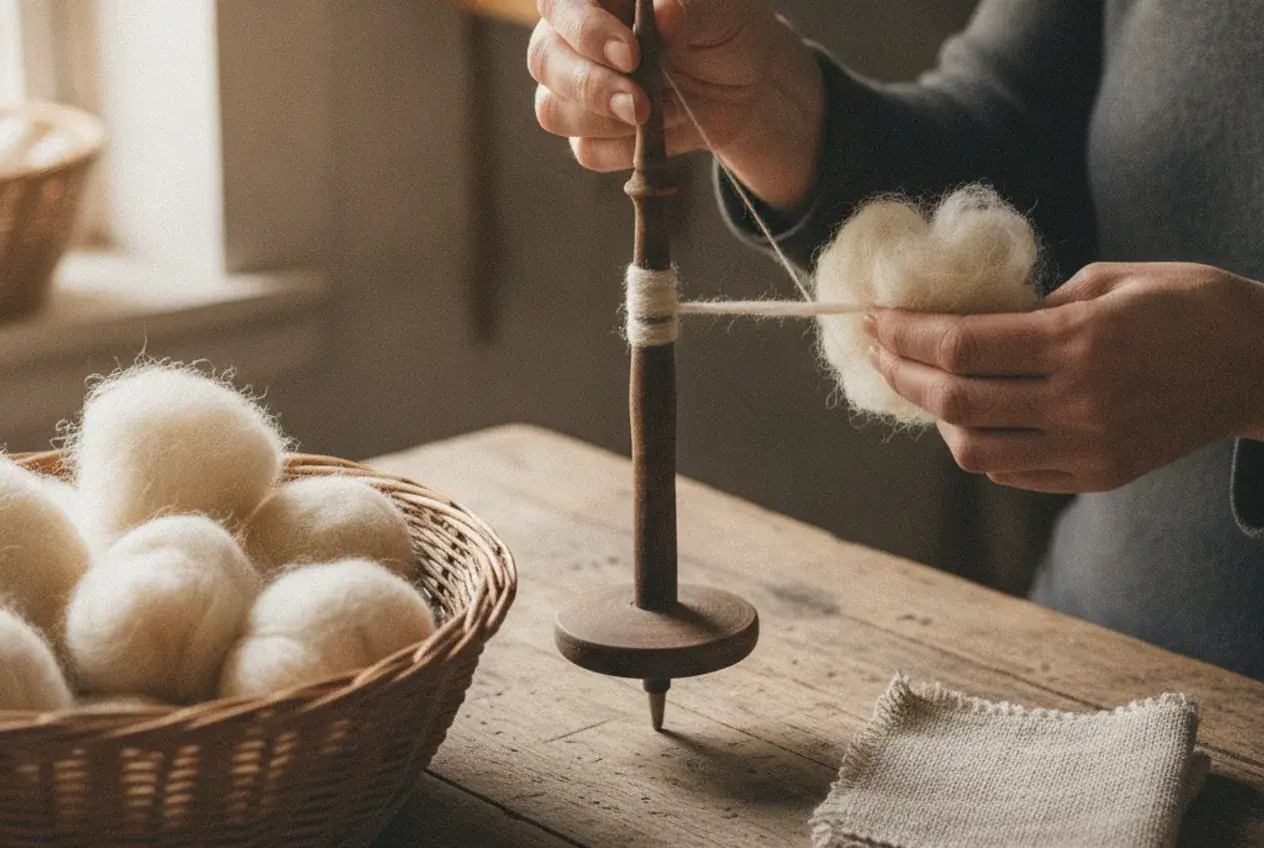
Getting from raw wool to something wearable is a shorter path than with flax. Washing happens in lukewarm water with a bit of wool detergent, without rubbing, or it felts by accident. Once dry, the wool gets carded, by hand with two carding brushes or with a drum carder, so the fibers line up in parallel. A hand spindle is enough to start with, a spinning wheel only pays off once quantities grow. Anyone who does not want to spin can skip that step entirely: wet felting turns carded wool straight into felt fabric using soap, water, and friction, and that is enough for simple garments like hats, slippers, or vests with no seams at all.
From thread to garment: a realistic roadmap
Historically, entire village communities spun through the winter months just to get enough yarn for one household's weaving. A single hand spindle or a single square meter of flax field does not change that math much. It is worth separating expectation from project early on.
Three tiers suit different levels of ambition. Getting a feel for it means one square meter of flax or a bag of raw wool, turned into a handkerchief, a ball of yarn, or a small piece of felt, over a weekend or a few weeks. A small project is a handspun scarf, a felted hat, or a set of cloth napkins from your own harvest, combined with bought yarn for the rest, spread across a whole season. A complete garment made entirely from your own fiber, on the other hand, realistically needs several ares of growing area, a group effort like the flax festivals, and years of practice.
For anything that needs to come together faster, ready-made fabric is worth a look. A large, already-hemmed cotton cloth needs no pattern at all: folded and secured with a few stitches or ties, it becomes a wrap skirt, a headscarf, or a simple poncho, with no cutting required. Around the house, these cloths already do the job of burp cloths, kitchen towels, or washcloths, and buying them almost always makes more sense there than the detour through your own fiber. Tested German Baumwolltücher (cotton cloths) comparisons help with picking one, when absorbency and wash durability matter for a baby or a kitchen.
| Fiber | Growing it yourself in Germany | Processing effort | Key point |
|---|---|---|---|
| Cotton | No, climate too cool | N/A | Buying it is the only option |
| Flax (linen) | Yes | High: retting, breaking, hackling | Germany's historical fiber crop, reviving since the 1980s |
| Hemp | Only for registered farmers | High, plus BLE reporting duty | Private cultivation not allowed, regardless of THC content |
| Wool | No cultivation needed | Medium: washing, carding, spinning or felting | Raw material often free from a local shepherd |
Frequently asked questions about growing your own clothes
Can I at least grow cotton in a greenhouse?
Yes, but only as a botanical curiosity. A heated greenhouse supplies the sustained 21 to 30 degrees needed, but yield per plant stays low, and the energy cost is out of proportion to any meaningful amount of textile fiber.
Can I grow hemp if I use an approved, low-THC variety?
No. According to the German Hemp Association, the ban on private individuals applies regardless of the variety's THC content. Only registered farmers and agricultural operations may grow industrial hemp, and they must report it to the BLE.
How much land do I need for a shirt made from my own flax?
Considerably more than the single square meter that projects like 1qm Lein work with. That is enough to experience the process once; a full garment needs several ares of growing area, which is why most beginners combine small home-grown projects with bought fabric.
Where can I get cheap raw wool?
The simplest route is asking a nearby shepherd directly, especially for wool from older breeds like Steinschaf or Heidschnucke. Since the market price barely covers shearing costs, many keepers are happy to give it away for free or for a small tip.
Do I need to know how to spin to make something wearable from wool?
No. Wet felting turns carded wool straight into felt using just soap and water, no spindle or spinning wheel needed, which is enough for hats, slippers, or simple vests. Spinning only pays off once you want woven or knitted fabric.
Sources
- Deutscher Hanfverband, "Ist der Anbau von Nutzhanf in Deutschland legal?", hanfverband.de, accessed 2026-09-14
- Technologie- und Förderzentrum (TFZ), "Lein (Linum usitatissimum L.)", tfz.bayern.de, accessed 2026-09-14
- TextilHandWerk e.V., "1qm Lein", 1qmlein.de, accessed 2026-09-14
- top agrar, "Markt für Schafwolle übersättigt", topagrar.com, accessed 2026-09-14
- Umweltbundesamt, "Veränderung der jahreszeitlichen Entwicklungsphasen bei Pflanzen", umweltbundesamt.de, accessed 2026-09-14
- Wikifarmer, "Cotton Growing Conditions", wikifarmer.com, accessed 2026-09-14
This content was created with AI assistance, primarily for research and drafting. Reviewed and approved by our editorial team.