TL;DR
Germany's 1st BImSchV requires proof that old wood stoves emit no more than 0.15 g/m³ particulate matter and 4 g/m³ carbon monoxide (Stufe 1). Stoves certified since 2015 must meet the stricter Stufe 2: 0.04 g/m³ particulate matter, 1.25 g/m³ CO. Every staggered transition deadline under Section 26 has now expired, the last one on 31 December 2024 for stoves built between 1995 and March 2010. If you can't produce proof, the law presumes non-compliance by default, and an individual measurement by the chimney sweep can then cost up to 2,000 EUR. Four exceptions still exist: pre-1950 stoves, open fireplaces, Grundöfen/cooking stoves under 15 kW, and hardship cases decided by your district chimney sweep.
For homesteaders who want wood as their primary heat source, the real question in 2026 isn't how to heat with wood anymore, it's which stove is even still allowed to run. Germany's 1st Federal Immission Control Ordinance (1. BImSchV) imposed a staggered retrofit-or-replace duty on older stoves, and its final deadline expired for good at the turn of 2024/2025. Anyone still running an unaddressed old unit risks not just a fine, but in the worst case, having the chimney sweep shut it down.
This article translates the ordinance's paragraph maze into a clear action guide: which limits apply and when, which deadlines have already passed, which four exceptions might still exempt you from retrofitting, and what retrofitting, replacement, or ignoring the rule actually costs.
What the 1st BImSchV actually regulates
The 1st BImSchV is Germany's ordinance on small and medium firing installations, and it covers what's called single-room heating appliances: wood stoves, tiled-stove inserts, pellet stoves, and solid-fuel ranges and cooking stoves. Open fireplaces, Grundöfen (traditional masonry stoves), and cooking stoves under 15 kW are excluded from the start, more on that below. For everything else, the ordinance distinguishes two emission tiers, tied to the stove's build or installation date.
The gap between the two tiers isn't a bureaucratic footnote, it's technically substantial: Tier 2 (Stufe 2) demands roughly three to four times less particulate matter and carbon monoxide than Tier 1 for the same combustion type.
The limits in detail: Stufe 1 vs. Stufe 2
Section 26 of the ordinance sets a single retrofit limit for existing installations built before 22 March 2010, regardless of the exact appliance type. Newly built installations from 31 December 2014 onward must instead meet the significantly stricter Stufe 2 limits in Annex 4 of the ordinance, with an additional tightening for pellet stoves.
| Category | Particulate matter | Carbon monoxide (CO) |
|---|---|---|
| Stufe 1 (retrofit limit for existing units built before 22 March 2010, Section 26) | max. 0.15 g/m³ | max. 4 g/m³ |
| Stufe 2 (new units since 31 Dec 2014, Annex 4) | max. 0.04 g/m³ | max. 1.25 g/m³ |
| Stufe 2, pellet stoves without water jacket | max. 0.03 g/m³ | max. 0.25 g/m³ |
| Stufe 2, pellet stoves with water jacket | max. 0.02 g/m³ | max. 0.25 g/m³ |
One important point of context: the Stufe 1 figures in the table above are not the manufacturer limits a stove was newly certified against in, say, 2010. They're the minimum an existing old unit must still meet after the transition deadline, whether through a particulate filter or another technical fix. If you can't produce that proof, the law treats the stove as non-compliant by default.
Note
These limit values were checked directly against the statutory text on gesetze-im-internet.de (Section 26 and Annex 4 of the 1st BImSchV) for this article. Two commercial heating-industry trade portals that also cite these figures served as the starting point, but were verified against the primary source.
The staggered deadlines have already expired
Section 26 tiers the retrofit duty by the stove's build date, readable on its nameplate or type approval certificate. If you don't know the build year, the earliest and therefore strictest deadline applies automatically.
| Stove build year | Deadline for retrofit, replacement, or shutdown |
|---|---|
| Up to 31 Dec 1974 (or build year unknown) | expired since 31 Dec 2014 |
| 1 Jan 1975 to 31 Dec 1984 | expired since 31 Dec 2017 |
| 1 Jan 1985 to 31 Dec 1994 | expired since 31 Dec 2020 |
| 1 Jan 1995 to 21 Mar 2010 | expired since 31 Dec 2024 |
With the last deadline on 31 December 2024, the transition scheme has fully run its course: any stove built up to 21 March 2010 that hasn't been retrofitted, replaced, or covered by one of the four exceptions has been out of compliance with current law since the start of 2025. In practice, that mostly hits stoves from the 1990s and early 2000s still running on many homesteads and in older housing stock, often precisely because they still work without any obvious problem.
Four exceptions from the retrofit duty
Not every old stove has to go. The ordinance names four situations where the retrofit duty either never applies or can be waived case by case.
- Historic fireplaces built before 1950: Stoves provably manufactured before 1 January 1950 and still standing at their original installation site are exempt from the retrofit duty.
- Open fireplaces used only occasionally: Fireplaces without a door or closing mechanism, operated only occasionally, fall outside the limit-value rules from the start.
- Grundöfen and cooking stoves under 15 kW: Traditional masonry Grundöfen (tiled stoves with their own thermal mass) and cooking stoves rated below 15 kW nominal output are also exempt.
- Hardship cases via the district chimney sweep: If the stove is your sole heat source, or a retrofit would be disproportionate, you can request an individual case review from your authorized district chimney sweep (Bezirksschornsteinfeger). This isn't an automatic exemption, it's the chimney sweep's judgment call.
Tip
Call your district chimney sweep before you spend money on a retrofit or replacement. They already know your specific unit, likely have the paperwork from your last chimney inspection, and can tell you in minutes whether one of the four exceptions applies, before you sink 500 to 6,000 EUR into a fix you might not need.
What you need to do now
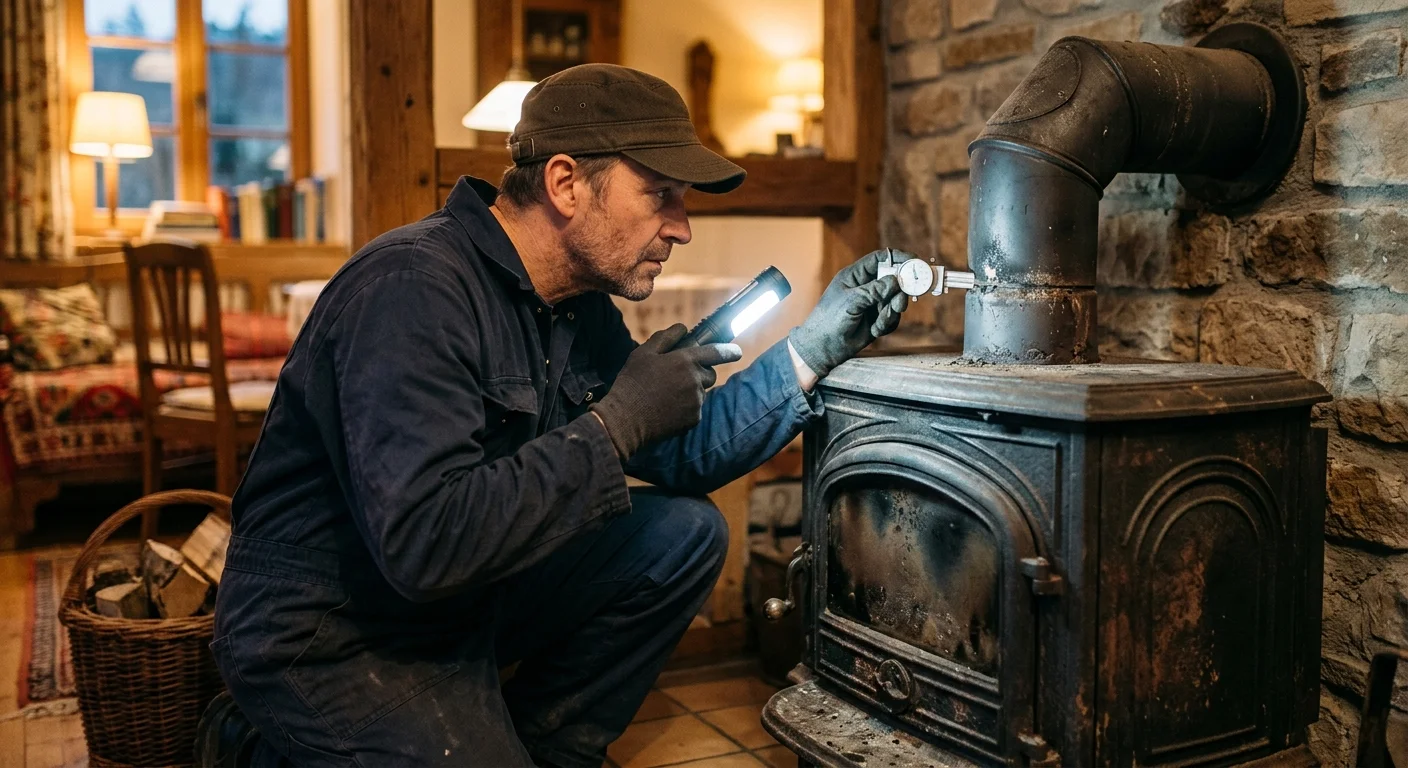
The first step is the same regardless of build year: find the proof. Most stoves from the 1990s onward come with a type approval or manufacturer certificate stating build year and emission figures. That paperwork should already have been filed with your district chimney sweep by 31 December 2012, if that never happened, catching up now is worth doing.
- Find the nameplate and paperwork: Note manufacturer, model, and build year, ideally with a photo of the nameplate on the stove itself.
- Ask the manufacturer for a copy of the compliance certificate: Many manufacturers reissue conformity certificates for older models on request, often for free.
- If no proof turns up, tell your chimney sweep: They can arrange an individual measurement before defaulting to a non-compliance finding and shutting the unit down.
- If it fails, decide your path: Retrofit with a particulate filter, full replacement, or check whether one of the four exceptions applies, see the cost section below.
Caution
Without proof, the law automatically presumes the limits aren't being met, and the burden of proof sits with you, not the chimney sweep. Keep running the stove without resolving that proof, and you risk a fine of up to 50,000 EUR.
Costs: retrofit, replace, or ignore
For a homesteading household planning on wood as its primary heat source, cost is the real decision driver. The figures below come from heating- and energy-advisory trade portals and are ballpark ranges, not binding fixed prices, actual costs depend heavily on the stove model and local tradesperson quotes.
| Measure | Cost |
|---|---|
| Individual measurement by the chimney sweep (no manufacturer proof) | up to 2,000 EUR |
| Retrofit with a particulate filter (incl. installation) | 500 to 2,000 EUR |
| Complete stove replacement | 3,000 to 6,000 EUR |
| Fine for non-compliance | up to 50,000 EUR |
Purely on the numbers, retrofitting with a filter is almost always the better bet compared to the individual measurement alone, since a measurement doesn't fix the compliance problem, it only confirms or disproves it. For very old or inefficient stoves, a full replacement is often the more economical route, since a new Stufe 2 stove burns less wood and you skip filter-retrofit costs on a unit that was already outdated anyway.
Permitted fuels: the second compliance angle
Even a fully retrofitted stove violates the ordinance if the wrong fuel goes in. Section 3 of the 1st BImSchV caps naturally seasoned firewood at a maximum of 25% residual moisture measured against dry weight, which roughly corresponds to two years of open storage under cover. Also permitted:
- Naturally seasoned firewood and wood chips: at a maximum of 25% residual moisture, bark included.
- Standardized wood briquettes: per DIN 51731.
- Wood pellets: per DIN EN ISO 17225-2 or an equivalent quality standard.
Burn freshly cut, still-green wood and you'll almost always blow past the moisture limit by a wide margin, regardless of how well the stove itself has been retrofitted. That matters practically too, since overly moist wood measurably worsens a stove's particulate output and can push even a Stufe 2 unit out of compliance.
Limits of this analysis
The limit values and deadlines in this article were checked directly against the statutory text on gesetze-im-internet.de and match the figures cited by the trade portals referenced here. The cost estimates for retrofitting, replacement, and individual measurement, by contrast, come solely from commercial sources in the heating industry, not from the ordinance itself, which doesn't regulate prices. Regional variation in tradesperson pricing and chimney sweep fees is therefore likely.
Whether one of the four exceptions actually applies in your specific case, especially the hardship exception via the district chimney sweep, is always decided by the authority on the ground, not by this article. For a real old stove, calling your own chimney sweep remains the most reliable first step.
Frequently asked questions about wood stoves and the 1st BImSchV
Is my old wood stove automatically illegal now?
Not automatically, but the burden of proof sits with you. If your stove was built before 22 March 2010 and you can't produce proof that it meets the limits (0.15 g/m³ particulate matter, 4 g/m³ CO), it's treated as non-compliant now that the final transition deadline expired on 31 December 2024. One of the four exceptions can still rebut that presumption.
How do I find out whether my stove meets the limits?
Start with the nameplate on the stove and any paperwork you have, a type approval or manufacturer certificate is often included. If it's missing, ask the manufacturer, many reissue copies of old conformity certificates. Only if nothing turns up does it come down to a paid individual measurement by your district chimney sweep.
What happens if I just do nothing?
Your chimney sweep flags the non-compliance to the responsible authority, and a fine of up to 50,000 EUR is possible. In practice, authorities usually set a retrofit or shutdown deadline before issuing a fine, but that's not something to count on.
Does the retrofit duty apply to my Grundofen or open fireplace too?
No. Grundöfen (traditional masonry tiled stoves), cooking stoves under 15 kW, and occasionally used open fireplaces are explicitly exempt from the 1st BImSchV's limit-value rules. A closed fireplace insert with a door, on the other hand, is very much covered.
What does a retrofit actually cost, filter versus new stove?
According to heating-industry trade portals, a particulate filter retrofit runs 500 to 2,000 EUR including installation, a complete stove replacement 3,000 to 6,000 EUR. For very old, inefficient stoves, replacement is often the more economical choice since it also cuts wood consumption.
Sources
- 1st BImSchV, Section 26, "Transition provisions for single-room heating appliances", gesetze-im-internet.de, accessed 2026-08-19
- 1st BImSchV, Annex 4, "Emission limit values for single-room heating appliances", gesetze-im-internet.de, accessed 2026-08-19
- "BImSchV 2026: Kaminofen-Austauschpflicht, Fristen & Grenzwerte", holzwaerme-mitterbauer.de, accessed 2026-08-19
- "Kaminofen-Verbot 2026: Fristen & Bestandsschutz", vamo-energy.com, accessed 2026-08-19
This content was created with AI assistance, primarily for research and drafting. Reviewed and approved by our editorial team.