TL;DR
Almost everyone with a German driving license has completed a 9-hour first aid course, usually years ago and never refreshed since. The course covers the baseline: CPR, the recovery position, stopping bleeding with a pressure dressing. It never expires, but providers recommend refreshing it every 3-4 years. Just as important as the knowledge is the equipment to go with it: Germany's Federal Office of Civil Protection (BBK) publishes an official home pharmacy checklist, stored cool and dry, never in the bathroom, checked at least once a year.
If you hold a German driving license, you've technically already completed a first aid course. That sounds reassuring, but it's only half the story: the course is a legal minimum requirement, not proof of current competence, and it says nothing about whether the right equipment is actually within reach when it matters.
This article gives an honest account of what the mandatory course for the driving license actually covers and where its limits are, then pairs that with a home pharmacy built around the official recommendation from Germany's Federal Office of Civil Protection and Disaster Assistance (BBK), not some generic prepper packing list. Together, these two form the baseline every further medical preparation builds on, not a substitute for it.
The mandatory driving-license course: what's actually required
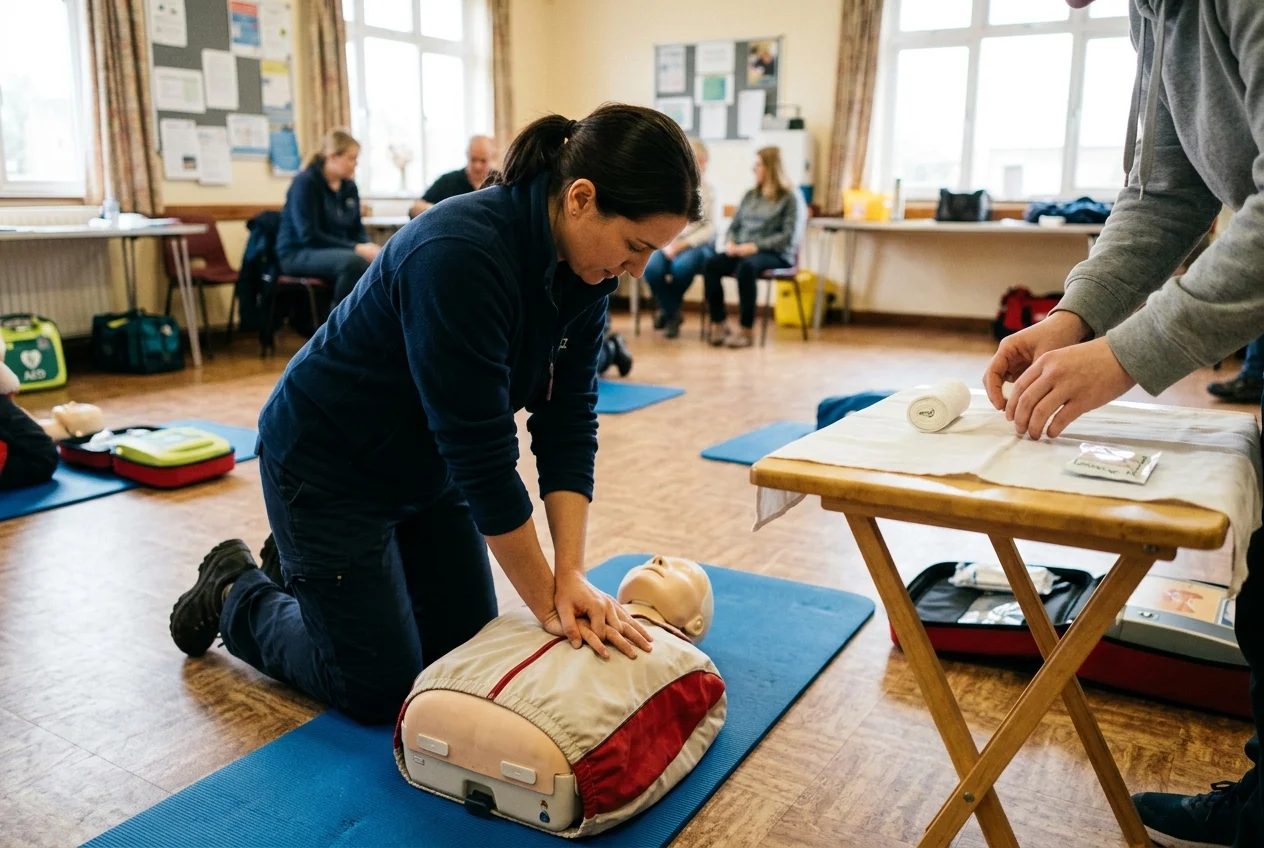
Anyone applying for a driving license in Germany must, under §19 of the Fahrerlaubnis-Verordnung (FeV, the driving license ordinance), provide proof of training in immediate measures at an accident scene. In practice, that means nine 90-minute units of first aid training with a recognized organization such as the DRK, Johanniter, Malteser, or ASB. Since 1 April 2015, a single unified course has applied to all license classes; before that, requirements varied by class.
That means the large majority of adults in Germany have completed this course at some point. That's exactly what makes it an underrated starting point. It's not exotic or hard to obtain, it's usually already sitting in a drawer somewhere, typically years or decades old and rarely refreshed.
| Content | What's taught |
|---|---|
| Cardiopulmonary resuscitation | Chest compressions and rescue breathing for cardiac arrest |
| Recovery position | Positioning an unconscious but breathing person |
| Stopping bleeding | Pressure dressing for heavily bleeding wounds |
| Accident scenarios | Response to traffic and household accidents |
| Other emergencies | Allergic reactions, shock, poisoning |
The course covers exactly the situations where every minute counts before emergency services arrive: resuscitation, positioning, stopping bleeding. Those are the three actions that can decide between life and death before anyone medically trained is even on scene.
Note
The course is deliberately broad and shallow so everyone can complete it in nine hours. It doesn't replace paramedic training, wilderness medicine, or the knowledge needed for a situation where emergency services are unreachable for hours or days. That requires further training, such as advanced first aid courses focused on trauma care or dedicated wilderness or disaster medicine instruction.
No expiry date, but a refresher still makes sense
Unlike the driving license itself, the first aid certificate in Germany carries no legal expiry date and no mandatory renewal. If you completed the course once for your driving license, you're not legally required to redo it, whether that was two years ago or twenty.
Even so, training providers themselves recommend a refresher every three to four years. The reasoning is straightforward, even without citing a specific study: skills practiced once during a nine-hour course and never again tend to get shakier over time. Resuscitation guidelines are also updated periodically, so a course from ten years ago no longer matches today's exact recommendations.
For anyone deliberately preparing for situations where professional help arrives late or not at all, that's a clear call to action: the old driving-license course is a foundation, not proof of current skill. A refresher usually takes a single day and costs noticeably less than the original training.
Tip
First check when you actually took your course. If it's been more than three to four years, a refresher with the DRK, Johanniter, Malteser, or ASB is the cheapest first step before investing in more equipment. Advanced courses focused on trauma care or wilderness medicine build directly on that refresher.
From knowledge to equipment: why the home pharmacy belongs here
First aid knowledge without the matching equipment stays theoretical. Someone who knows how to apply a pressure dressing but has no sterile bandaging material at home still can't act on it when it counts. That's why a home pharmacy is inseparable from the foundation the course lays, not an optional extra but a necessary complement.
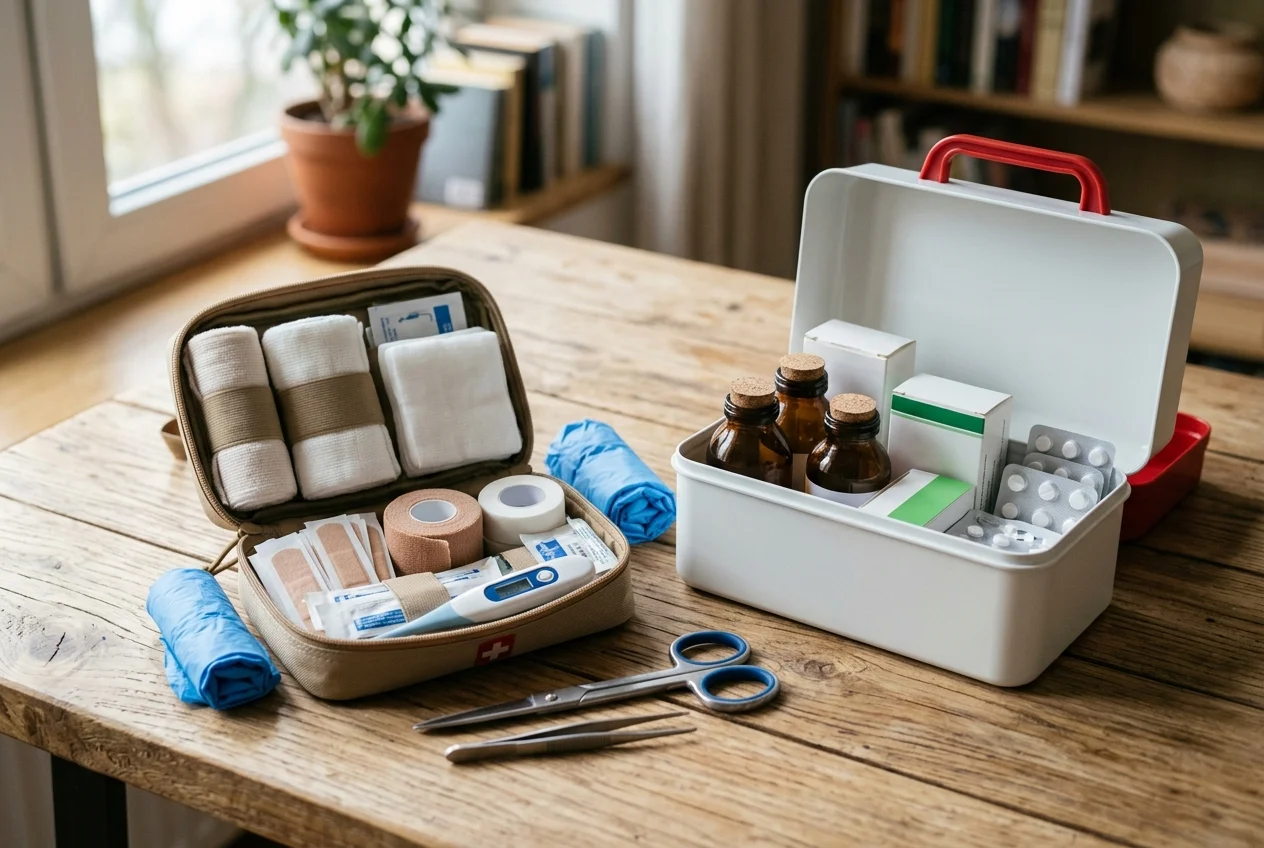
Germany's Federal Office of Civil Protection and Disaster Assistance (BBK) publishes its own official recommendation for exactly this. It's deliberately not a product catalog but a list of functional categories, from which every household assembles its own home pharmacy to fit its own situation.
| Category | Why it belongs in the home pharmacy |
|---|---|
| Personal prescribed medications | Ongoing prescriptions must not run out in an emergency, regardless of anything else |
| Pain and fever relievers | Covers the most common everyday complaints |
| Clinical thermometer | The baseline for judging whether medical care is needed |
| Tweezers | For removing splinters, ticks, and foreign objects |
| Nasal decongestant spray | Eases breathing during a cold, frequently needed |
| Cold remedies | Bridges the first days of a cold without a doctor's visit |
| Anti-diarrheal and anti-nausea medication | Prevents rapid deterioration, especially in children and the elderly |
| Oral electrolyte solution | Replaces fluid and salt lost through diarrhea or vomiting |
| Wound and burn ointment, skin disinfectant | Prevents infection in minor injuries |
| Disposable gloves | Protects both helper and injured person during treatment |
| Bandaging material | Basic equipment for wound care of any kind |
| Burn dressing cloth | Specifically for larger burns, cools and covers sterilely |
| Scissors | For cutting bandaging material and cutting away clothing |
| Cold compress | For bruises, sprains, and minor burns |
| Anti-inflammatory gel | For minor sports injuries, strains, and bruises |
| Sunburn and insect-bite remedies | Covers the most common summer leisure mishaps |
The logic behind this list is consistent: it covers exactly the complaints that come up most often in ordinary daily life, plus the baseline equipment to treat the injuries covered in the first aid course. It's deliberately not equipment for severe trauma or surgical procedures, which belong in professional hands, but for the cases where self-treatment is sensible and sufficient.
Storage and upkeep: the two mistakes people make most often
A complete home pharmacy isn't much use if it's kept in the wrong place or nobody checks what's still usable inside it. The BBK gives clear guidance here, and most of it is easy to put into practice in any household.
- Don't store it in the bathroom: This is the single most common mistake. The humidity and heat from showers degrade many medications and bandaging materials, causing them to lose effectiveness faster. A cool, dry spot like a bedroom or hallway cabinet works much better.
- Accessible but child-safe: The home pharmacy needs to be reachable quickly in an emergency, while also being secured so children can't get to medications unsupervised. A lockable cabinet or a high-up shelf solves both at once.
- Check it regularly: Bandaging material loses its sterility, medications reach their expiry date. Secondary sources describing the pharmacists' association (ABDA) practice mention reviewing the contents at least once a year as a sensible benchmark, and consistently replacing anything expired. That's not a primary official recommendation, but it lines up with the BBK's own guidance to check regularly.
Note
According to the BBK, the exact contents should match personal need: someone with a chronic condition, small children, or a remote home needs a different home pharmacy than a healthy single person in a city with a pharmacy around the corner. The BBK list is the starting point, not the final answer.
Know the limits: what neither the course nor the pharmacy replaces
The mandatory driving-license course and a well-stocked home pharmacy are a solid foundation, but explicitly not training for situations where professional help is unreachable for hours or days. Neither includes prescription-only medication nor instructions for invasive procedures like injections, IV lines, or surgical intervention, that belongs in trained hands or in further courses with the appropriate qualification.
Anyone who wants to go beyond the baseline, toward wilderness medicine or extended trauma care for example, should treat that as a deliberate next step rather than trying to close the gap with equipment alone. Equipment without training creates a false sense of security that can be more dangerous in an emergency than no preparation at all.
Warning
This article does not replace medical training or professional medical advice. Prescription-only medication, injections, and invasive procedures belong exclusively in the hands of medical professionals or appropriately trained first responders. Always call emergency services for serious injuries or illness.
Frequently asked questions about first aid and the home pharmacy
Is my old driving-license first aid course enough for a real emergency?
Legally the certificate never expires, but practically it does. Providers like the DRK or Johanniter recommend a refresher every three to four years, since practiced skills like chest compressions get shakier over time and resuscitation guidelines can change.
Do I have to take the driving-license course with a specific organization?
No, any state-recognized organization works, such as the DRK, Johanniter, Malteser, or ASB. What matters is that the course covers the nine 90-minute units required under §19 FeV, unified across all license classes since 2015.
Why does the BBK recommend against storing the home pharmacy in the bathroom?
Humidity and heat from showering degrade medication and sterile bandaging material, causing them to become unusable faster. A cool, dry room such as a bedroom or hallway cabinet is a much better fit.
How often should I check my home pharmacy?
The BBK calls for regular checks without naming a fixed interval. Secondary sources describing pharmacists' association practice suggest at least once a year as a sensible benchmark for replacing expired or unusable items.
What's the next step after the mandatory course and home pharmacy?
Anyone who regularly spends time in remote areas or wants to prepare for situations without fast access to emergency services should pursue further training, such as courses focused on trauma care or wilderness medicine, rather than just buying more equipment without the training to match.
Sources
- "Erste-Hilfe-Kurs für Führerschein und Fahrerlaubnis", bussgeldkatalog.org, accessed 2026-08-17
- "Erste-Hilfe-Kurs Führerschein", Johanniter-Unfall-Hilfe, accessed 2026-08-17
- "Wann müssen Sie einen Erste-Hilfe-Kurs absolvieren?", bussgeldrechner.org, accessed 2026-08-17
- "Im Notfall schnell einsatzbereit: Die Hausapotheke", Federal Office of Civil Protection and Disaster Assistance (BBK), accessed 2026-08-17
- "Die Hausapotheke: Gerüstet für den Notfall", pkv-institut.de, accessed 2026-08-17
This content was created with AI assistance, primarily for research and drafting. Reviewed and approved by our editorial team.