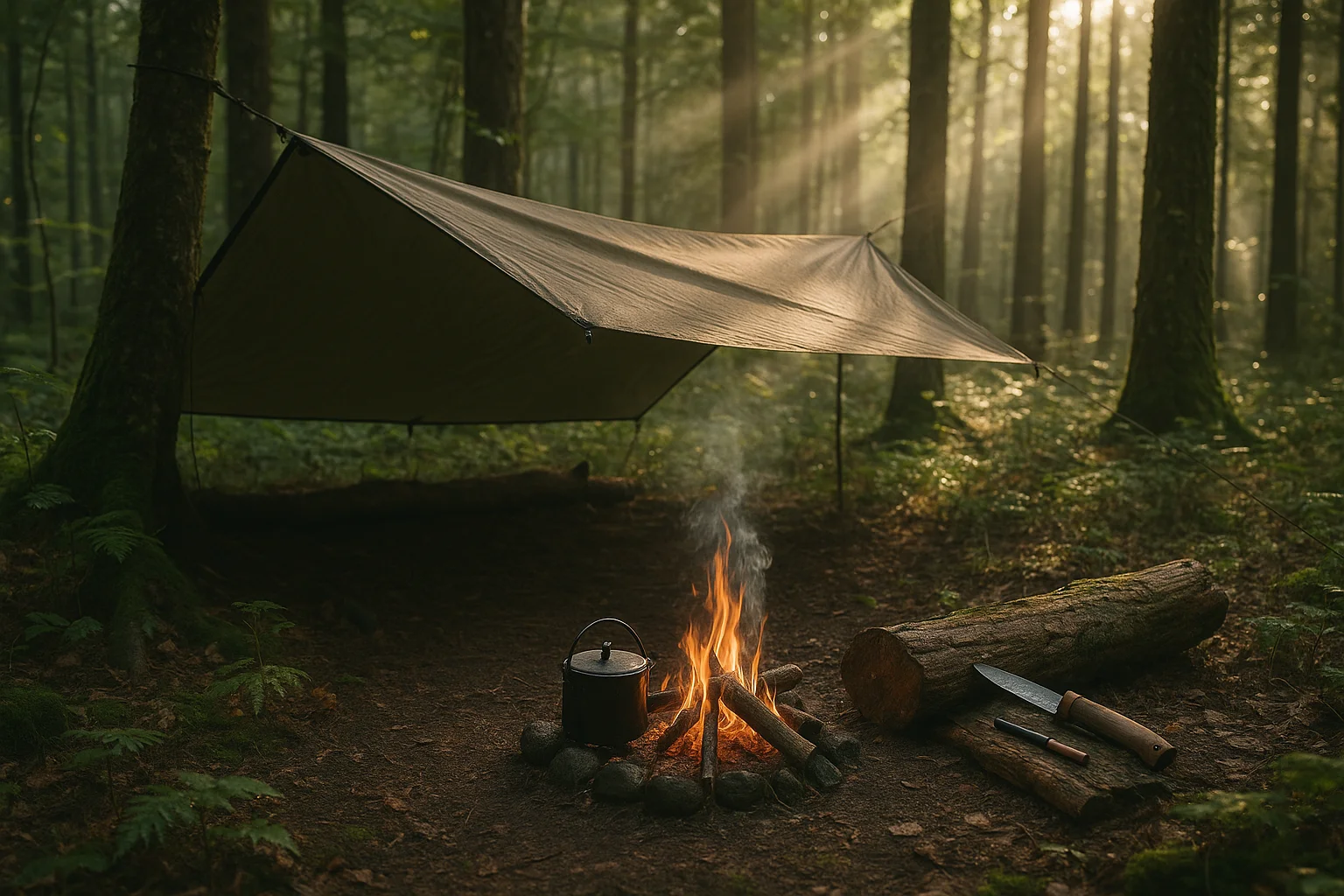
Bushcraft isn't a hobby for extremists. It's humanity's oldest skill set: getting along with nature. Unlike survival (staying alive in an emergency) or camping (comfort through equipment), bushcraft is about being capable in nature with minimal tools, long-term.
TL;DR: 10 foundational skills in logical order take you from zero to a solid base. You don't need expensive gear, just practice. This guide gives you the learning sequence, concrete practice plans, and the legal framework in Germany.
Bushcraft vs. Survival vs. Camping: The Difference
The terms are often mixed up. The distinction matters because it determines what you practice and why.
| Discipline | Mindset | Equipment | Time Horizon |
|---|---|---|---|
| Bushcraft | WITH nature | Minimal (knife, tarp, fire steel) | Long-term, skill replaces gear |
| Survival | AGAINST nature | Nothing or improvised | Short-term, survive until rescue |
| Camping | Comfort IN nature | Lots (tent, stove, sleeping bag) | Gear replaces skill |
Bushcraft is the middle ground: you learn skills that make you more capable in everyday life and emergencies alike. And yes, it's fun, because you quickly realize how much you can achieve with very little.
The 10 Core Skills in Learning Order
The order matters. Each skill builds on the previous one. Don't skip ahead, because a knife you can't handle safely is more dangerous than no knife at all.
- Knife safety and handling: Basic grips: standard grip, thumb grip, chest lever grip. Always carve away from your body. Practice: 30 minutes of feather sticks until you produce even curls consistently.
- Fire with matches: Sounds simple, it isn't. Learn the tinder ladder: birch bark or dry grass as tinder, thumb-thick sticks as kindling, then larger fuel. Practice: get a fire going in under 5 minutes, in wind.
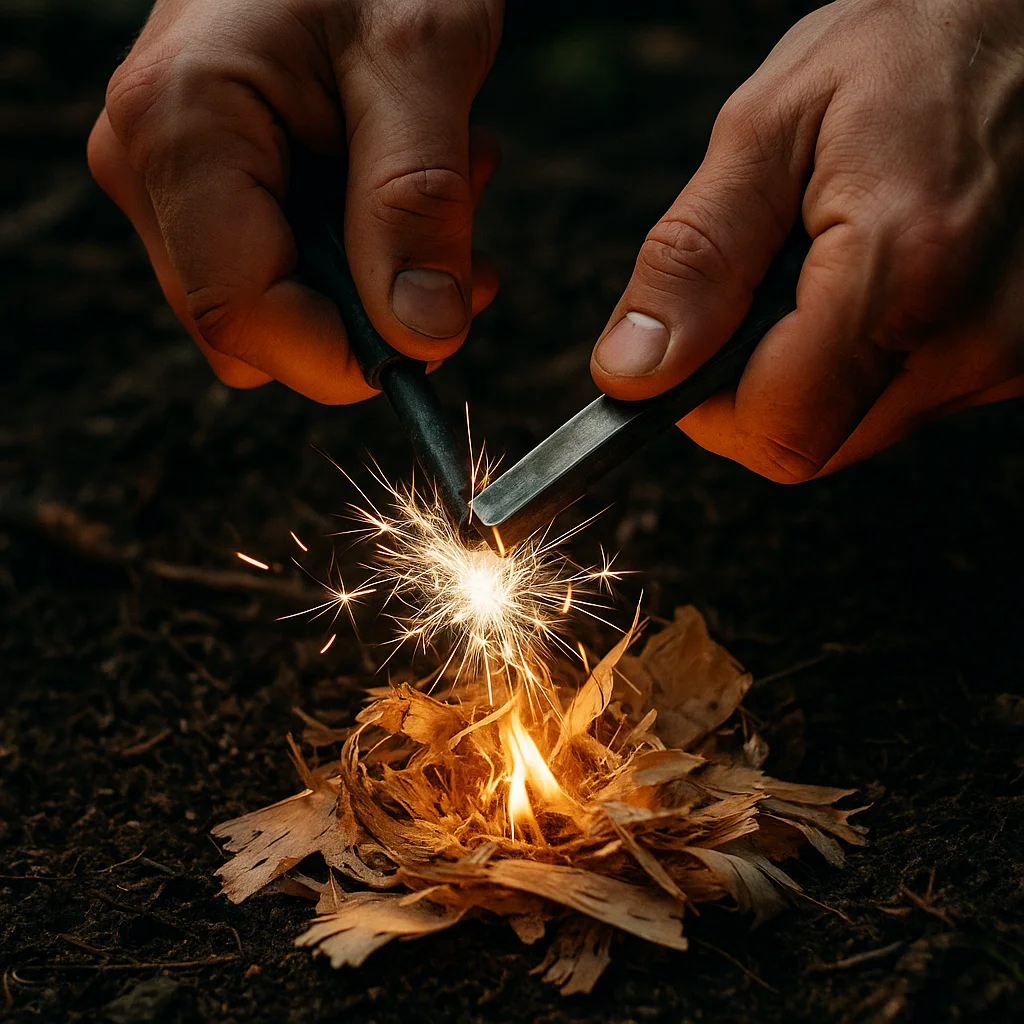
- Fire with ferro rod: A ferro rod works wet and at 3,000 m altitude. Practice: 10x per session with different tinders (birch bark, cotton, fatwood, cattail). Goal: reliable ignition in under 30 seconds.
- Build a tarp shelter: A 3x3 m tarp and 15 m of paracord yield dozens of configurations: A-frame, lean-to, diamond, plough point. Practice: set up each configuration in under 10 minutes. Sleep a night in it.
- Water filtering and boiling: Water treatment in 3 stages: pre-filter (t-shirt/bandana), chemical (Micropur) or mechanical (Sawyer Mini), boiling (3 minutes rolling). Practice: make stream water safe to drink.
- Master 5 essential knots: Bowline (fixed loop), timber hitch (securing logs), taut-line hitch (tensioning tarp), Prusik (climbable, slip-proof), clove hitch (quick and releasable). Practice: tie each knot blindfolded in 10 seconds.
- Map and compass navigation: GPS fails, phone battery dies. Orient the map, take a bearing, calculate march compass number. Practice: walk a 5 km route using only map and compass, off-trail.
- Tools from natural materials: Forked branch as pot hanger, hardwood wedge for splitting, carving a spoon. Practice: carve a functional eating spoon from a hand-length piece of wood (takes 45-60 min).
- Outdoor first aid: Treating cuts, cooling burns, removing ticks, recognizing shock, treating hypothermia. Practice: take a first aid course plus an outdoor-specific supplement.
- Reading the weather: Identify cloud types (cumulus, cumulonimbus, cirrus), interpret wind direction and pressure changes, assess thunderstorm risk. Practice: predict the weather each morning for 2 weeks and check each evening.
The order isn't arbitrary: skills 1 through 3 make you capable in cold and wet conditions, skills 4 through 6 secure shelter and drinking water, and the last four take you from bare survival to real competence. Run through all ten once, and you'll notice quickly: the most valuable tool at the end isn't the priciest knife, it's your own experience.
Legal Framework in Germany
Bushcraft in Germany is possible, but you operate within a tight legal framework. Ignorance of the law is no defense.
- Fire in forests: Prohibited in most German states (state forest law). Exception: designated fire pits. From March 1 to October 31, additional wildfire regulations apply in many states.
- Wild camping: Generally prohibited in Germany. Exceptions: some official trekking camps (Rhineland-Palatinate, Baden-Württemberg, Bavaria). Absolutely forbidden in nature reserves.
- Carrying knives: Fixed-blade knives over 12 cm blade length are restricted in public spaces (Weapons Act). In the forest: carrying is allowed with a legitimate reason (bushcraft qualifies).
- Collecting wood: Dead wood on the ground may be collected for personal use in most states. Damaging living trees is prohibited. Sawing or felling trees requires the landowner's permission.
Important
Practice in nature only with the landowner's permission or in designated areas. Bushcraft camps and wilderness schools offer legal practice grounds. In your own garden, you can practice almost everything, including fire (in a fire pit).
In short: the skills themselves are legal everywhere, you can learn wherever you like. What you actually do with them is bound by clear limits. Where you're allowed to light a fire, where you're allowed to sleep, and which knife you can carry all come down not to your skill level, but to the state law of wherever you happen to be standing.
Where Can You Legally Practice?
The biggest hurdle for bushcraft beginners in Germany isn't ability, it's permission. Here are your options:
- Your own garden: Knife work, knot practice, fire (fire bowl), tarp setup. The simplest and safest option for regular practice.
- Bushcraft camps / wilderness schools: Professional courses with legal framework, equipment, and guidance. Costs 80-250 EUR per weekend, but you learn in 2 days what takes months alone.
- Private forest with permission: Ask forest owners directly. Many appreciate someone who treats the forest with respect. Written permission is worth its weight in gold.
- Official trekking camps: Designated nature camping spots in several German states. Bookable, legal, in the middle of nature. Perfect for overnight practice.
- Scandinavia (Right to Roam): In Sweden, Norway, and Finland, the Right to Roam permits wild camping, fires (with care), and free movement in nature. Ideal for longer bushcraft trips.
These five options aren't mutually exclusive, they build on each other. The garden gives you daily repetition, the wilderness school gives you structured feedback, and Scandinavia eventually gives you an environment where you can apply everything at once without constantly checking permissions and no-camping signs.
Tip
Start with your garden and a bushcraft weekend at a wilderness school. The combination of 15 minutes daily knife and knot work in the garden plus a structured course will take you further in 3 months than a year of YouTube tutorials.
Essential Gear: What You Actually Need
Bushcraft thrives on minimalism. Less gear means more skill development. Here's the essentials: every item covers several of the ten skills at once, nothing on this list is a single-purpose gadget.
- Knife: Fixed blade, 10-12 cm blade length, Scandi grind (easy to resharpen). Recommendation: Morakniv Companion (25 EUR) or Morakniv Garberg (80 EUR).
- Ferro rod: At least 10 mm diameter (thinner ones break easily). Produces sparks at 3,000+ degrees. 10-15 EUR.
- Tarp: 3x3 m, silnylon or polyester. Lightweight (400-600 g), waterproof, versatile. 30-80 EUR.
- Paracord: 15-20 m, 550-type (4 mm). Holds 250 kg, inner strands work as sewing thread. 5-10 EUR.
- Stainless steel bottle: 1 liter, single-wall (can go directly into fire). Double-wall = explosion risk. 15-20 EUR.
Total cost: 85-205 EUR. That's everything you need for the first 10 skills. Everything else is optional and can be added later.
Frequently Asked Questions About Bushcraft Fundamentals
Do I need prior outdoor experience?
No. The 10 skills start from zero. You need no scouting background or special fitness. Start with knife and fire in your garden; everything else follows naturally.
Is bushcraft dangerous?
No more dangerous than cooking or DIY, if you follow the basic rules. The biggest risks: cuts (always carve away from body), burns (never leave fire unattended), and hypothermia (wet clothes in cold weather).
Can I learn bushcraft on my own?
Much of it, yes, via video and books. But a course at a wilderness school accelerates the learning process enormously because you get direct feedback. Learn knife work and fire starting alone; learn navigation and first aid in a course.
Which knife for beginners?
Morakniv Companion (about 25 EUR). Scandi grind, robust, easy to sharpen. Many professionals use it as their secondary or primary knife. Don't buy a Rambo knife; you need a clean blade for carving, not a combat knife.
How often should I practice?
15 minutes daily beats 3 hours on the weekend. Carve feather sticks for 10 minutes every evening, practice knots for 5 minutes while watching TV. Motor learning needs repetition, not duration.