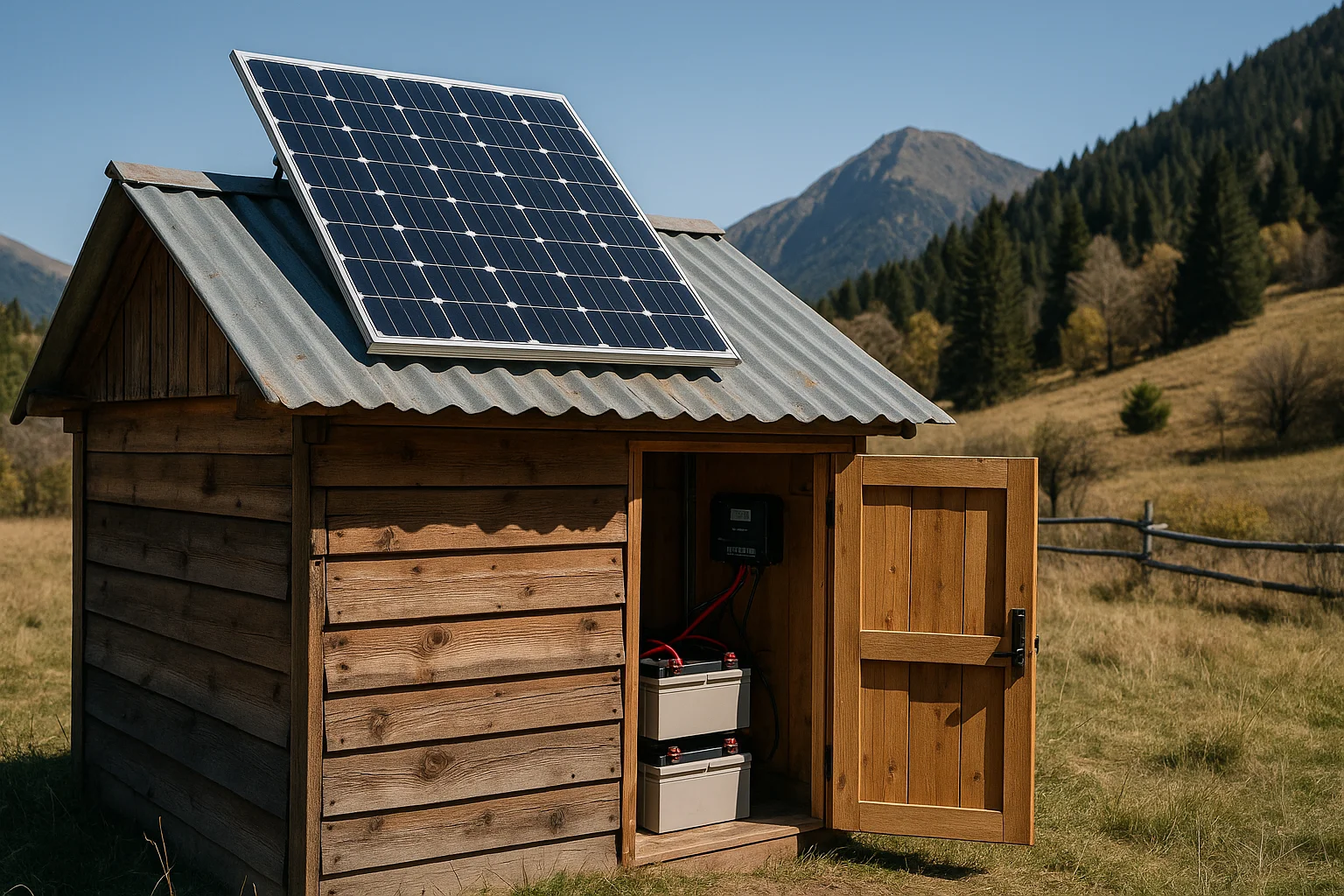
An off-grid solar system consists of four components: solar panels, charge controller, battery bank, and inverter. The challenge isn't buying, it's sizing. Get the math wrong, and you'll sit in the dark in winter or waste money on oversized equipment.
TL;DR: Measure your daily consumption in Wh, divide by your location's sun hours, and you have the required panel wattage. For storage, multiply daily consumption by autonomy days and divide by depth of discharge. Sounds complex, but it isn't. This guide walks you through the calculation step by step.
The 4 Components of an Off-Grid System
Every off-grid solar system consists of the same four building blocks. Understand each component's job, and you can plan any system yourself.
| Component | Unit | Function |
|---|---|---|
| Solar panels | Wp (Wattpeak) | Convert sunlight to DC electricity. Rated under standard test conditions (STC). |
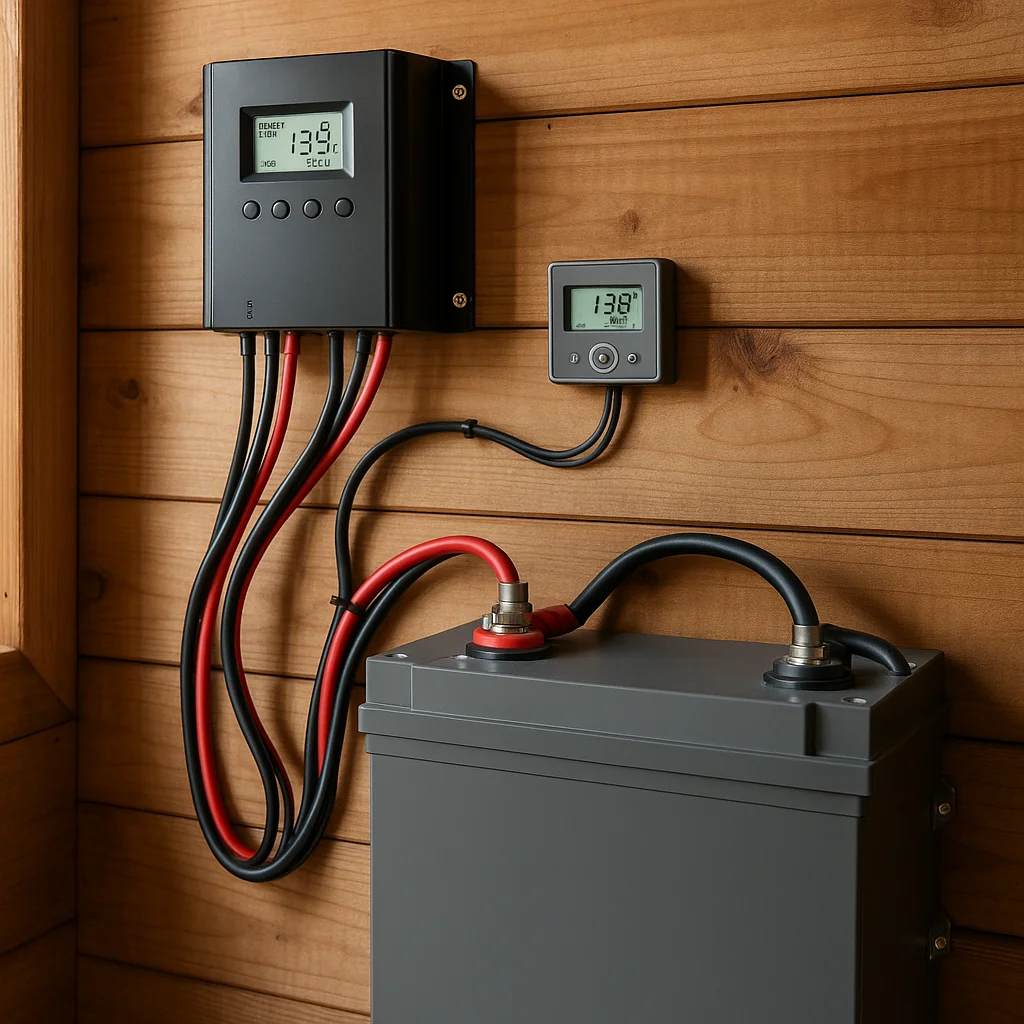
| Charge controller | A (Ampere) | Regulates battery charging. MPPT is 20-30% more efficient than PWM and essential above 400 Wp. |
| Battery bank | Ah / kWh | Stores energy for nighttime and overcast days. Largest single cost of the system. |
| Inverter | W (Watts) | Converts 12/24/48V DC to 230V AC. Must handle peak load of all simultaneous consumers. |
Note
MPPT vs. PWM: An MPPT charge controller (Maximum Power Point Tracking) extracts 20-30% more yield from your panels than a PWM controller. Below 200 Wp with matching panel/battery voltage, PWM works fine. Above that, MPPT is always the better economic choice.
The four components form a chain, not independent parts. If one loses capacity, it drags the others down with it: an undersized charge controller caps your charging current even on a bright day when the panels could deliver more. An undersized battery forces you to waste power you generated during the day because there's nowhere to put it. That's why it pays to plan the system as a whole instead of buying each component separately and finding out too late that one link is too weak.
The Calculation: From Consumption to System Size
The entire sizing process follows four steps. Master these four steps, and you can calculate any off-grid system yourself.
- Determine daily consumption in Wh: List all appliances: Power (W) x operating hours per day = Wh per day. Example: LED light 10W x 5h = 50 Wh, laptop 60W x 4h = 240 Wh, fridge 50W x 24h x 0.3 (duty cycle) = 360 Wh. Add everything for total daily consumption.
- Calculate required panel wattage: Daily consumption (Wh) / sun hours at your location / 0.85 (system losses) = required Wp. Size for the worst month (winter) if you want year-round autonomy.
- Calculate battery capacity: Daily consumption (Wh) x autonomy days / depth of discharge (DoD) / battery voltage = required Ah. Autonomy days: 2-3 for summer use, 4-5 for year-round operation.
- Determine inverter size: Add the wattage of all appliances that could run simultaneously. Add 20% headroom. Caution: motor-driven appliances (fridge, pump) have startup surges 3-5x their rated power.
These four steps depend on each other, they aren't independent line items. Buy the inverter first and size the battery around it afterward, and you've reversed the order, you'll often end up with a system that checks out on paper but binds in the wrong place once it's running. Work through the steps in the order above, and round every value up rather than down at the end: headroom is cheap before the purchase, expensive after it.
Average Daily Sun Hours in Germany
| Month | Sun Hours/Day | Rating |
|---|---|---|
| January | 1.5 h | Critical: Minimal yield |
| February | 2.5 h | Weak |
| March | 3.5 h | Adequate |
| April | 5.0 h | Good |
| May | 6.0 h | Very good |
| June | 6.5 h | Peak |
| July | 6.0 h | Very good |
| August | 5.5 h | Good |
| September | 4.0 h | Adequate |
| October | 2.5 h | Weak |
| November | 1.5 h | Critical |
| December | 1.0 h | Critical: Minimum |
| Annual average | ~3.5 h | Southern Germany up to 4.0 h |
The annual average of roughly 3.5 hours is misleading: it hides the fact that yield between December and June differs by more than sixfold. Plan around the average, and you'll end up with an oversized system in summer that still can't keep up in winter. For a system meant to carry you through the whole year, only the worst month counts, not the average.
Battery Comparison: AGM vs. LiFePO4
The battery is the most expensive single component and determines your system's lifespan. Two technologies dominate the market:
| Property | AGM (Lead) | LiFePO4 (Lithium) |
|---|---|---|
| Cycles | 300-500 | 3,000-5,000 |
| Depth of discharge (DoD) | 50% | 80-90% |
| Price per kWh | 150-200 EUR | 400-600 EUR |
| Usable capacity | 50% of rated | 80-90% of rated |
| Weight (100Ah/12V) | ~30 kg | ~12 kg |
| Lifespan | 2-4 years | 8-15 years |
| Cost per cycle/kWh | ~0.40 EUR | ~0.10 EUR |
Bottom line: AGM is cheaper upfront; LiFePO4 is cheaper long-term per stored kWh. For a weekend cabin, AGM works. For anything used daily, LiFePO4 is the better choice.
3 Practical Examples: From Weekend Cabin to Full Supply
Theory is good, practice is better. Here are three typical scenarios with fully calculated systems:
The jump between the three scenarios isn't linear. Consumption roughly triples going from the weekend cabin to the tiny house, but the voltage level already jumps from 12V to 24V, because at matched voltage the required cable cross-sections become impractical. Full-house supply usually adds a fridge, washing machine, and water heater running at once, and it's those motor- and heating-element-driven appliances that end up sizing the inverter, not the raw daily consumption figure.
| Scenario | Consumption | Panels | Battery | Cost approx. |
|---|---|---|---|---|
| Weekend cabin | 1 kWh/day | 2x 200 Wp | 100 Ah LiFePO4 (12V) | ~1,500 EUR |
| Tiny house | 3 kWh/day | 6x 200 Wp | 300 Ah LiFePO4 (24V) | ~5,000 EUR |
| Full house supply | 8 kWh/day | 16x 200 Wp | 800 Ah LiFePO4 (48V) | ~15,000 EUR |
These prices are indicative for 2026 and include all four components plus cabling and small parts. DIY assembly saves 30-50% compared to professional installation.
Warning: Winter Gap
In Germany, a solar system produces only 15-25% of summer output from November through February. For year-round autonomy, you need either massively oversized panels or a backup source (generator, wind, grid connection). Plan the winter gap realistically.
The 5 Most Common Off-Grid Solar Mistakes
Most first-system mistakes aren't math errors, they're omissions: a factor that gets forgotten when sizing simply because it doesn't show up in any of the four core formulas above. The following five points come up again and again in unplanned retrofits.
- Ignoring the winter gap: Sizing for summer and wondering why nothing works in December. Always size for the worst month or have a backup solution.
- Battery too small: Calculating for just one night when winter brings 3-4 overcast days in a row. Plan for at least 2 autonomy days, better 3-4.
- PWM instead of MPPT: For systems over 400 Wp, a PWM controller loses up to 30% yield. The MPPT price premium (50-150 EUR) pays for itself in months.
- Cables too thin: Thin cables mean high resistance and voltage drop. At 12V, a 1000W load draws over 80A. Use cable cross-section calculators and oversize rather than undersize.
- No fuses: Every string needs a fuse. Between battery and inverter, install a main switch and a slow-blow fuse. Without fuses, you risk cable fires.
Every single one of these is a free fix before you buy, but almost none of them are a free fix afterward: you don't just swap out a cable that's too thin once everything is run and clamped down.
Tip
Start small and expand. A 12V system with 400 Wp and 100 Ah LiFePO4 is a perfect learning system. Once you understand the basics, you can scale up to 24V or 48V.
Frequently Asked Questions About Off-Grid Solar
Do I need a permit for an off-grid solar system?
For a standalone system without grid feed-in, you typically don't need a permit. If you want grid connection (hybrid), different rules apply (registration with grid operator, market master data register). Pure off-grid systems don't fall under the German Renewable Energy Act (EEG).
Can I install an off-grid system myself?
You can build the DC side (solar panels, charge controller, battery) yourself. The AC side (inverter, 230V wiring) should be signed off by an electrician. In case of insurance claims, proper installation will be questioned.
How long does an off-grid solar system last?
Solar panels: 25-30 years (performance warranty usually 25 years at 80%). Charge controller/inverter: 10-15 years. LiFePO4 batteries: 8-15 years. The panels outlast everything else; electronics and batteries get replaced over time.
12V, 24V, or 48V system?
12V: Simple, for systems up to 1 kW. 24V: Standard choice for 1-3 kW, halves the current vs. 12V. 48V: For larger systems above 3 kW, lowest cable cross-sections and losses. Rule of thumb: the larger the system, the higher the voltage.
What do I do about the winter gap?
Options: (1) Generator as backup (gasoline or propane), (2) Add a wind turbine (wind is stronger in winter), (3) Reduce winter consumption (LED instead of bulbs, gas stove instead of electric), (4) Grid connection as hybrid solution.