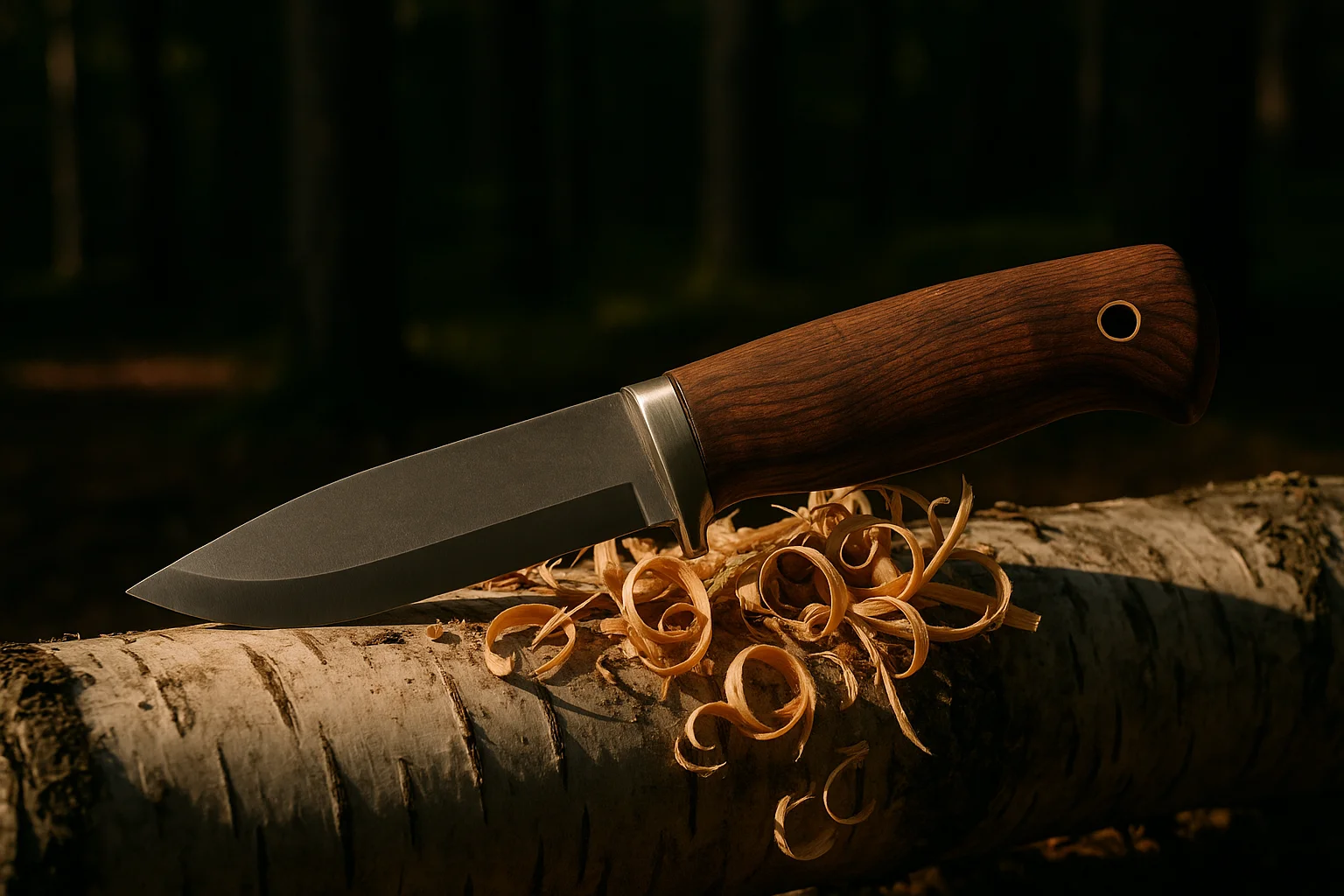
TL;DR
A good bushcraft knife has a 9-12 cm blade, full-tang construction, and a Scandi or saber grind. Carbon steel is sharper and easier to sharpen; stainless is lower maintenance. 50 EUR gets you a solid knife (Morakniv Companion HD). In Germany, fixed blades over 12 cm require a legitimate reason to carry in public.
The knife debate in the bushcraft community never ends. Everyone has an opinion, few back it up with reasoning. In reality, the choice comes down to five measurable criteria that determine real-world usability.
This guide shows you what actually matters in a bushcraft knife, which steel and grind types suit which tasks, and three knives across different price ranges that reliably get the job done.
The 5 real criteria for a bushcraft knife
Forget marketing speak. A bushcraft knife needs to carve, baton (split wood), cut feathersticks, and process food. For that, you need exactly these five properties:
- Blade length 9-12 cm: Short enough for fine work, long enough for batoning. Under 9 cm makes splitting wood tedious; over 12 cm loses control for carving and creates legal issues in Germany.
- Full-tang construction: The steel runs continuously to the end of the handle. No rat-tang (just a thin steel pin in the handle). A rat-tang knife will eventually break during batoning.
- Steel choice: carbon or stainless: No objectively better choice. Carbon gets sharper and is easier to sharpen. Stainless is lower maintenance. Your priorities decide.
- Grind type: Scandi or saber: Scandi grind is the bushcraft classic. Saber/flat grind is tougher and more versatile. Both work; the sharpening method differs.
- Handle ergonomics: The handle must sit securely in wet and cold hands. No smooth metal or plastic surfaces. Wood, Micarta, or textured rubber are ideal. A slight guard prevents slipping forward onto the blade.
These five criteria aren't mutually exclusive, quite the opposite: a good bushcraft knife satisfies all five at once. Miss one, and you usually won't notice until a few weeks into the field, exactly when the situation the missing criterion was meant for shows up.
Carbon vs. stainless: An honest comparison
The steel question divides the community. Here are the facts without ideology:
| Property | Carbon (1095, O1) | Stainless (12C27, 14C28N) |
|---|---|---|
| Sharpness | Very sharp, finer grain | Sharp, slightly coarser grain |
| Ease of sharpening | Easy, even on field stones | Somewhat harder, needs decent stones |
| Corrosion | Rusts without care | Rust-free (normal use) |
| Fire steel | Works with ferro rod | Doesn't work reliably |
| Maintenance | Keep dry, oil regularly | Minimal, rinse and dry |
| Price tendency | Slightly cheaper | Slightly more expensive |
Note
If you want to strike sparks with a ferro rod, you need carbon steel. The hard, high-carbon edge tears particles off the ferro rod. Stainless steel is too soft for this.
Scandi vs. saber: Which grind for which task?
The grind determines how your knife cuts and how you sharpen it. The two relevant options for bushcraft:
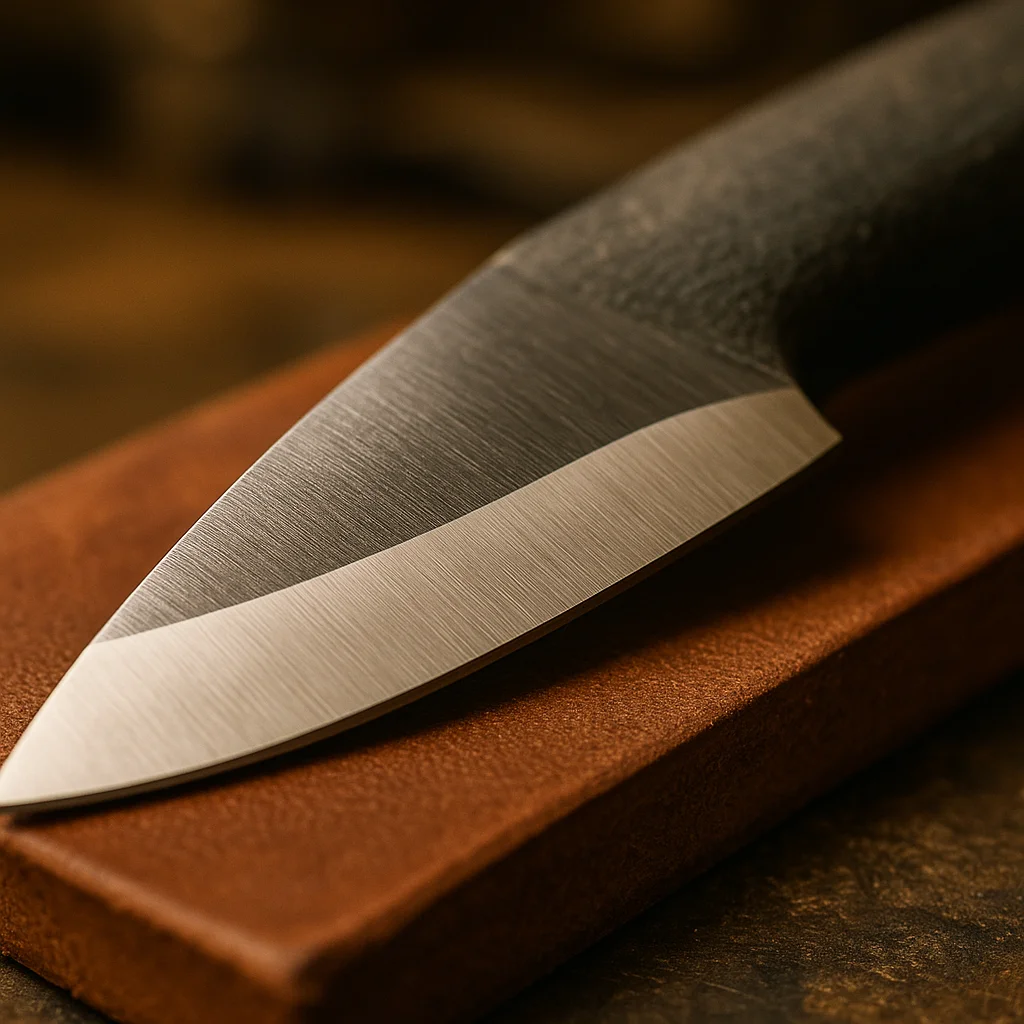
- Scandi grind: Flat wedge without a secondary bevel. The entire blade face sits flat on the stone during sharpening. Extremely easy to sharpen in the field, very thin, ideal for woodwork and carving. Downside: the thin edge is more fragile and can chip when batoning hardwood.
- Saber/flat grind: The blade face tapers towards the edge, with a small secondary bevel at the cutting edge. Tougher than Scandi, more versatile, but slightly harder to sharpen because you need to hold the angle of the secondary bevel.
3 knife recommendations by price range
No affiliate links, no deals. Three knives that have proven themselves in practice:
- Budget (~50 EUR): Morakniv Companion HD. Carbon steel, Scandi grind, 10.4 cm blade. Not full tang, but the construction handles batoning. Best value on the market. Only downside: the plastic handle gets slippery in cold weather.
- Mid-range (~150 EUR): Helle Temagami. Laminated steel (14C28N core), full tang, birch wood handle. Norwegian craftsmanship. Scandi grind, 11 cm blade. Excellent hand feel and built to last.
- Premium (~400 EUR): Bark River Bravo 1.25. A2 tool steel (semi-stainless), full tang, saber grind, 11.1 cm blade. Massively built, survives everything. Various handle materials available. The investment for people who use their knife daily.
Going from 50 to 400 EUR doesn't buy you eight times the performance, it buys better materials, craftsmanship, and longevity. For your first years of bushcraft, the budget knife covers you completely.
Tip
Buy your first knife cheap (Morakniv). Work with it for a year. Then you'll know what you're missing and what you actually need. Upgrading to a more expensive knife makes sense after that.
German knife law: What you're allowed to carry
The German Weapons Act (WaffG) regulates carrying knives in public. The rules are clear but often misrepresented:
- Fixed blades over 12 cm: Carrying in public is prohibited (§42a WaffG). Exception: legitimate interest, e.g. hiking, hunting, bushcraft, fishing. You must be able to credibly state the reason.
- Fixed blades under 12 cm: Legal to carry, as long as it's not a prohibited knife type (no switchblades, no gravity knives).
- On your own property: No restrictions. You may own and use any legal knife at home.
In practice: if you're visibly on your way to hike or camp, a blade over 12 cm rarely causes problems. It only gets risky when the context doesn't fit the legitimate-interest justification, say in a pedestrian zone or on the way to a football stadium.
Important
Always transport your bushcraft knife locked and not readily accessible (e.g. in your backpack inside its sheath). This avoids problems even with blades over 12 cm. When in doubt: choose a blade under 12 cm.
Maintenance: Making your knife last
A good knife lasts decades with proper care. The effort is minimal:
- Dry after every use: Moisture is the enemy, especially with carbon steel. Wipe the blade, let it dry, only then put it back in the sheath.
- Lightly oil carbon steel: Thin layer of camellia oil or Ballistol on the blade. No cooking oil, it goes rancid.
- Strop the edge regularly: Every few uses, strop the edge on a leather strop. This realigns the fine burr and maintains sharpness longer.
- Sharpen on stone 1-2x per year: When stropping no longer restores the edge, it's time for the whetstone. With a Scandi grind, lay the bevel flat on the stone and draw evenly. A 1000-grit stone handles most needs.
These four steps together take less than 10 minutes a month but add years to your knife's life. Neglected maintenance is the main reason a good knife goes dull or rusty ahead of its time.
Frequently asked questions about bushcraft knives
Is a Morakniv really enough for bushcraft?
Yes. The Morakniv Companion HD is the most widely used bushcraft knife in the world. It cuts, batons, and gets razor sharp again in 5 minutes. For 50 EUR, there's no better tool. Upgrading to something pricier only makes sense once you know what you're missing.
Can I use a ferro rod with a stainless steel knife?
Only with difficulty. Most ferro rod kits come with a dedicated scraper. The spine of a stainless steel knife barely produces sparks. Carbon steel works better because the harder edge tears particles off the ferro rod.
How often should I sharpen my knife?
Strop after every extended use. Sharpen on a stone 1-2 times per year with normal use. If you're batoning and carving daily, more often. A dull knife is more dangerous than a sharp one because you need more force.
Is batoning bad for the knife?
With a full-tang knife of adequate blade thickness (3-4 mm), batoning is no problem. Avoid it with rat-tang knives and very thin blades. Always strike the spine with a piece of wood, never with a stone.
Can I carry my bushcraft knife in the woods?
Yes. Bushcraft, hiking, and outdoor activities count as legitimate interest under German law (§42a WaffG). You may carry your knife openly on your belt when visibly headed to or in the woods. On your way through town, tuck it into your backpack.