TL;DR
In 2006, Germany became the first country in Europe to receive a general building-authority type approval (abZ) for straw bales as an insulation material, issued by the DIBt to the German straw bale building association FASBA. That approval (most recently Z-23.11-1595) expired on February 1, 2019, and has never been renewed. Since 2017, a product-specific European Technical Assessment, ETA-17/0247, covers certified "Baustroh" instead, supplemented since 2024 by FASBA's straw-building guideline, which explicitly is not a recognized rule of technology. For non-load-bearing insulation in timber-frame construction, permitting usually proceeds normally; for load-bearing straw bale construction, individual case approval from the state's top building authority is always required.
A cob oven on a weekend is one thing. Insulating an entire house with straw bales, or building load-bearing walls out of them, is another: real building law applies here, and the legal picture shifted fundamentally in 2019, a shift most online guides never noticed.
Read "straw bales are an approved building material in Germany" today and you usually get only half the story from 2006. This article covers what actually governs straw bale construction since the old approval expired in 2019, which document has taken over its role, and where the line runs between routine permitting and a lengthy individual-case review. It complements our article on earth building for beginners, which covers weekend projects like a cob oven, by moving up to load-bearing construction: this is about walls, insulation, and building permits for a whole structure.
Two construction methods, one material
In practice, "straw bale construction" covers two very different structural approaches, and German law treats them differently:
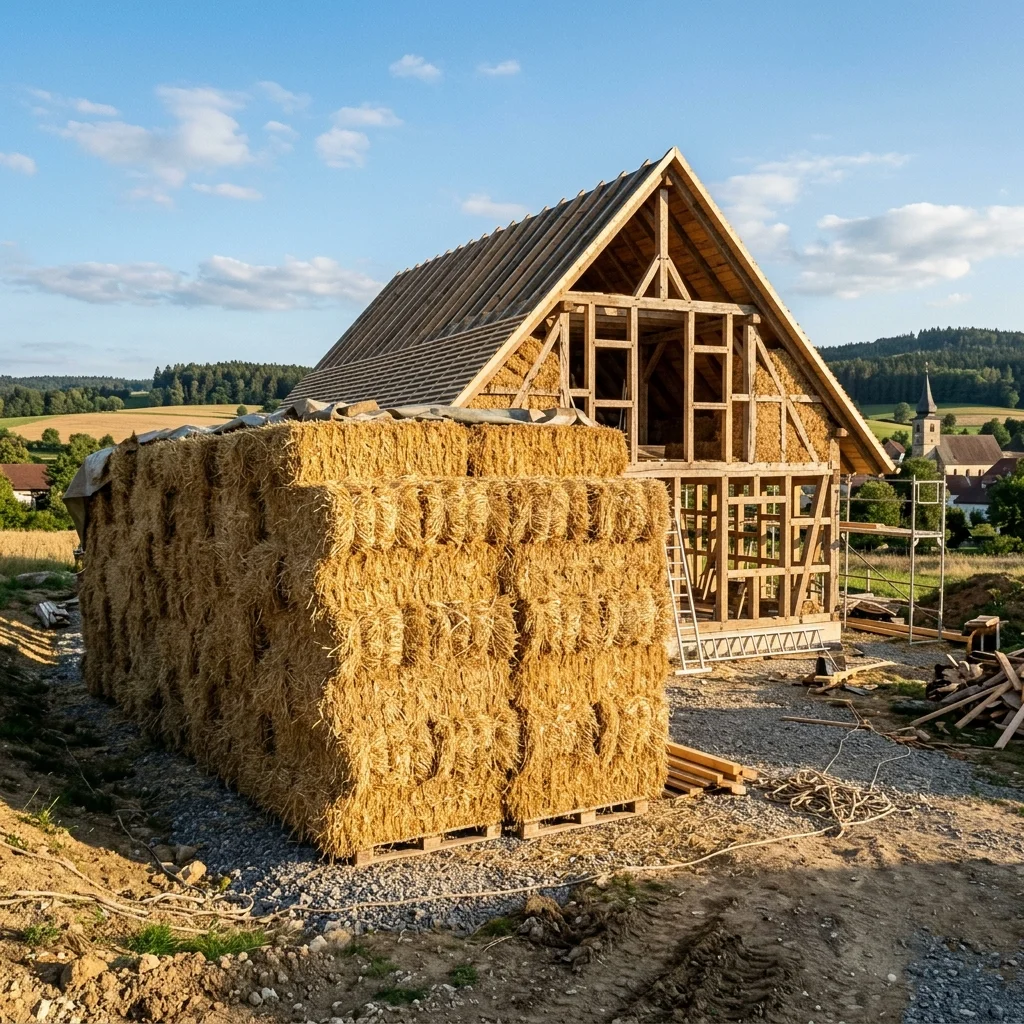
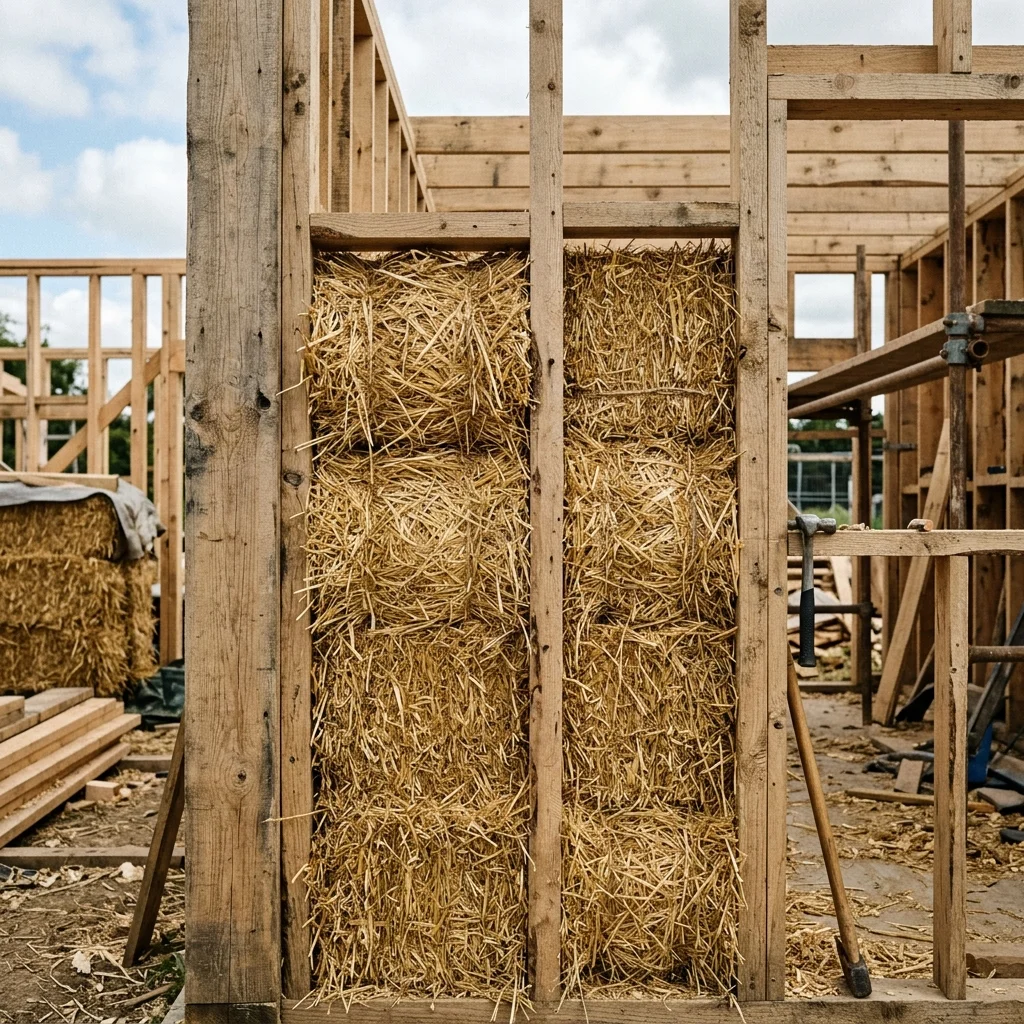
- Non-load-bearing infill in timber-frame construction: A wood-stud frame carries the roof and floors, and straw bales fill the bays between the studs, serving purely as insulation. This is by far the dominant approach built in Germany today.
- Load-bearing bale construction: The straw bales themselves carry the roof load, with no timber frame in between. This method, which originated in Nebraska, is technically feasible but remains the exception under German building law.
For the first approach, there is now a workable, if more complicated, path to a building permit. For the second, there isn't, more on that below.
The 2006 approval and its quiet expiry in 2019
In 2006, the German Institute for Building Technology (DIBt) granted the Fachverband Strohballenbau Deutschland e.V. (FASBA) Europe's first general building-authority type approval (abZ) for straw bales as a non-load-bearing insulation material. That was a genuine first: no other European country had a comparable document at the time. The approval was reissued several times, most recently under the number Z-23.11-1595, in a version dated June 3, 2014.
That last version is exactly where most online guides stop researching. Z-23.11-1595 was only valid until February 1, 2019, and it has not been renewed since. This can be verified directly in the DIBt's official approval database, which lists the approval's current status as expired.
| Year | Event |
|---|---|
| 2006 | Europe's first abZ for straw bales as insulation (DIBt to FASBA) |
| 2014 | Last reissue as Z-23.11-1595, including direct plastering with clay or lime |
| February 1, 2019 | Approval expires, no renewal, still no new abZ as of today |
Important
The line "straw bales have been an approved insulation material in Germany since 2006" has not been blanket-true since February 1, 2019, even though many guides still state it unchanged. Nationwide, there is no longer a general building-authority type approval for straw bales as a material class. Planning based on this outdated legal understanding risks permit delays and, at worst, rejection. What actually governs it now is covered in the next section.
What actually governs construction in 2026: a European assessment instead of a national approval
The legal framework didn't simply disappear in 2019, it became more complicated and narrower. Because FASBA, as a registered association, couldn't run commercial certification itself, BauStroh GmbH was founded to do that, also based in Verden. Since June 21, 2017, that company has held the European Technical Assessment (ETA) ETA-17/0247 for the product "Baustroh," issued by the DIBt acting as the technical assessment body, based on the European Assessment Document EAD 040146-00-1201. The associated Declaration of Performance was last updated in March 2025, meaning the assessment remains active.
The crucial detail most accounts miss: this ETA is not a replacement in the same legal sense as the old abZ. The abZ covered the entire material class of "straw bales" once the test criteria were met, regardless of supplier. ETA-17/0247, by contrast, is a product-specific assessment, tied to the branded product "Baustroh" certified by BauStroh GmbH with defined density, moisture content, and testing. Straw bales from a neighboring farm that aren't part of that certification don't automatically fall under it.
Note
An ETA is not a national type-approval document; it's a European, product-specific technical assessment under the EU Construction Products Regulation that enables CE marking. Functionally, it replaces the old German abZ for certified "Baustroh," but its scope is narrower: it applies to one manufacturer's certified product, not to straw bales as a material class in general.
Since 2024, this is supplemented by FASBA's Strohbaurichtlinie (straw-building guideline), which replaces the 2019 predecessor version. It lists documented, practice-proven constructions as approvable, but by FASBA's own account it explicitly does not carry the status of a "recognized rule of technology." That's a legal distinction with real practical weight: a recognized rule of technology carries a presumption of correctness before authorities, an association guideline does not. Still, the guideline helps enormously in practice, because it hands inspectors and building authorities concrete, already-proven solutions instead of requiring a fresh justification every time.
| Instrument | Scope | Legal nature |
|---|---|---|
| abZ Z-23.11-1595 (until 02/01/2019) | Straw bales as a material class | Nationwide type approval, expired |
| ETA-17/0247 (since 2017, still active) | Certified "Baustroh" from BauStroh GmbH | Product-specific European assessment with CE marking |
| Strohbaurichtlinie 2024 (FASBA) | Documented, proven constructions | Association guideline, not a recognized rule of technology |
| Load-bearing straw bale construction | Individual case | Case-by-case approval, state's top building authority |
Building permits in practice
Despite the more complicated legal picture, the practical path to a permit is manageable for most self-builders, as long as the construction method fits:
- Talk to the local building authority early: Many building offices have little experience with straw bales. An early, informal conversation prevents bad surprises mid-process.
- Use only certified "Baustroh": Only bales certified under ETA-17/0247 fall under the standard permitting procedure like any other building material.
- Base the design on the Strohbaurichtlinie: Choosing one of the constructions documented in FASBA's current straw-building guideline makes review considerably easier for the authority than an entirely novel solution.
- Non-load-bearing infill in timber-frame construction: According to FASBA, this proceeds like any other building as long as points 2 and 3 are met. No special procedure needed.
- Load-bearing construction or uncertified bales: Always requires applying for individual case approval from the state's top building authority, typically through a specialist planner experienced in straw construction.
Tip
Bring the ETA data sheet for "Baustroh" and the current FASBA Strohbaurichtlinie to your first meeting with the building authority instead of just describing "approval since 2006" verbally. Many caseworkers aren't aware the legal situation changed, and they're often glad to have solid documentation they can put straight into the file.
Insulation values and building physics
Regardless of the approval question, straw holds up well on building physics. The figures below come from the technical documentation for certified Baustroh and apply to that tested bale quality, not to arbitrary field straw:
| Property | Value |
|---|---|
| Raw density | 85-115 kg/m³ |
| Thermal conductivity λ (design value) | 0.049 W/(m·K) |
| Fire resistance class with 8 mm clay plaster | F-30-B |
| Fire resistance class with 10 mm lime plaster | F-90-B |
| Specific heat capacity | 2.0 kJ/(kg·K) |
| Sound insulation, plastered wall (Rw,R) | 43-44 dB |
For comparison: conventional mineral wool sits around 0.035-0.040 W/(m·K), so slightly better on paper than straw. But because straw bale walls are typically much thicker than conventional insulation layers (36-48 cm is common), they often reach similar or better U-values in practice than more slender conventional walls, while adding substantial thermal mass through the plaster on both sides.
Plastering: clay or lime straight onto straw
Since the 2014 reissue, the abZ of the time also covered plastering straw bales directly with clay or lime, without a separate plaster-carrier layer in between. For self-builders, that's the most practically valuable part of the whole story, because it lets you combine straw bale construction and earth building directly: if you already know the basic techniques from our earth building for beginners article, you can apply them straight to the wall surfaces of a straw-insulated building, just at a larger scale.
As the table above shows, the difference between the two plaster types isn't just cosmetic: lime plaster at 10 mm reaches the considerably higher fire resistance class F-90-B, while clay plaster at 8 mm stays at F-30-B. For exterior walls, where fire resistance matters more, lime is therefore often the preferred choice, while clay plaster tends to win indoors for its moisture-regulating effect.
Load-bearing straw bale construction: the special case
For load-bearing bale construction, where the straw bales themselves carry the roof, the legal picture differs from infill construction. Neither the old abZ nor today's ETA-17/0247 covered or covers this method, because both apply exclusively to straw as a non-load-bearing insulation material. Load-bearing straw bale construction therefore always requires individual case approval from the state's top building authority, along with a structural load-bearing analysis from an engineer.
This isn't a new problem created in 2019, it has always been the case: load-bearing straw bale construction was never blanket-approved in Germany, not even during the old abZ's validity period. Anyone planning this method should bring in an experienced structural engineer from the start and expect a considerably longer, more involved permitting process than for infill construction with certified Baustroh.
Frequently asked questions about straw bale construction
Is straw bale construction still legal in Germany in 2026?
Yes, but no longer blanket-approved the way it was between 2006 and 2019. For non-load-bearing insulation in timber-frame construction using certified Baustroh, permitting again runs about as routinely as for any other building. For anything that deviates from that, the responsible authority has to be convinced on a case-by-case basis.
What's the difference between the old abZ and today's ETA?
The abZ covered the entire material class nationwide, regardless of supplier, as long as test criteria were met. ETA-17/0247 is instead a product-specific European assessment tied to the branded product Baustroh certified by BauStroh GmbH. Straw bales outside that certification don't automatically fall under it.
Can I use straw bales from a neighboring farm instead of certified Baustroh?
Legally possible, but considerably more work. Without certification as Baustroh under ETA-17/0247, no routine procedure applies, and you need individual case approval from the state's top building authority instead. For most self-builders, certified Baustroh is by far the simpler path.
Is load-bearing straw bale construction allowed in Germany?
In principle yes, but only through individual case approval from the state's top building authority, backed by a structural analysis. A nationwide blanket approval for this method has never existed, not under the old abZ and not under today's ETA.
Can I plaster straw walls directly with clay, like a cob oven?
Yes, direct plastering with clay or lime without a plaster-carrier layer was part of the 2014 abZ version and is documented as a proven construction in the current Strohbaurichtlinie. Lime plaster gives noticeably higher fire resistance than clay plaster.
Sources
- Baulinks, "Strohballen als Wärmedämmstoff vom DIBt zugelassen", 2006, accessed 2026-08-19
- DIBt approval database, detail page Z-23.11-1595, accessed 2026-08-19
- Baulinks, "Erweiterte Zulassung macht Dämmen mit Baustroh für weitere Zielgruppen attraktiv", 2014, accessed 2026-08-19
- EOTA, ETAssessment 17/0247 "Baustroh", accessed 2026-08-19
- FASBA, "Baugenehmigung", accessed 2026-08-19
- FASBA, "Strohbaurichtlinie", 2024, accessed 2026-08-19
- FASBA, "Eigenschaften und technische Daten", accessed 2026-08-19
This content was created with AI assistance, primarily for research and drafting. Reviewed and approved by our editorial team.