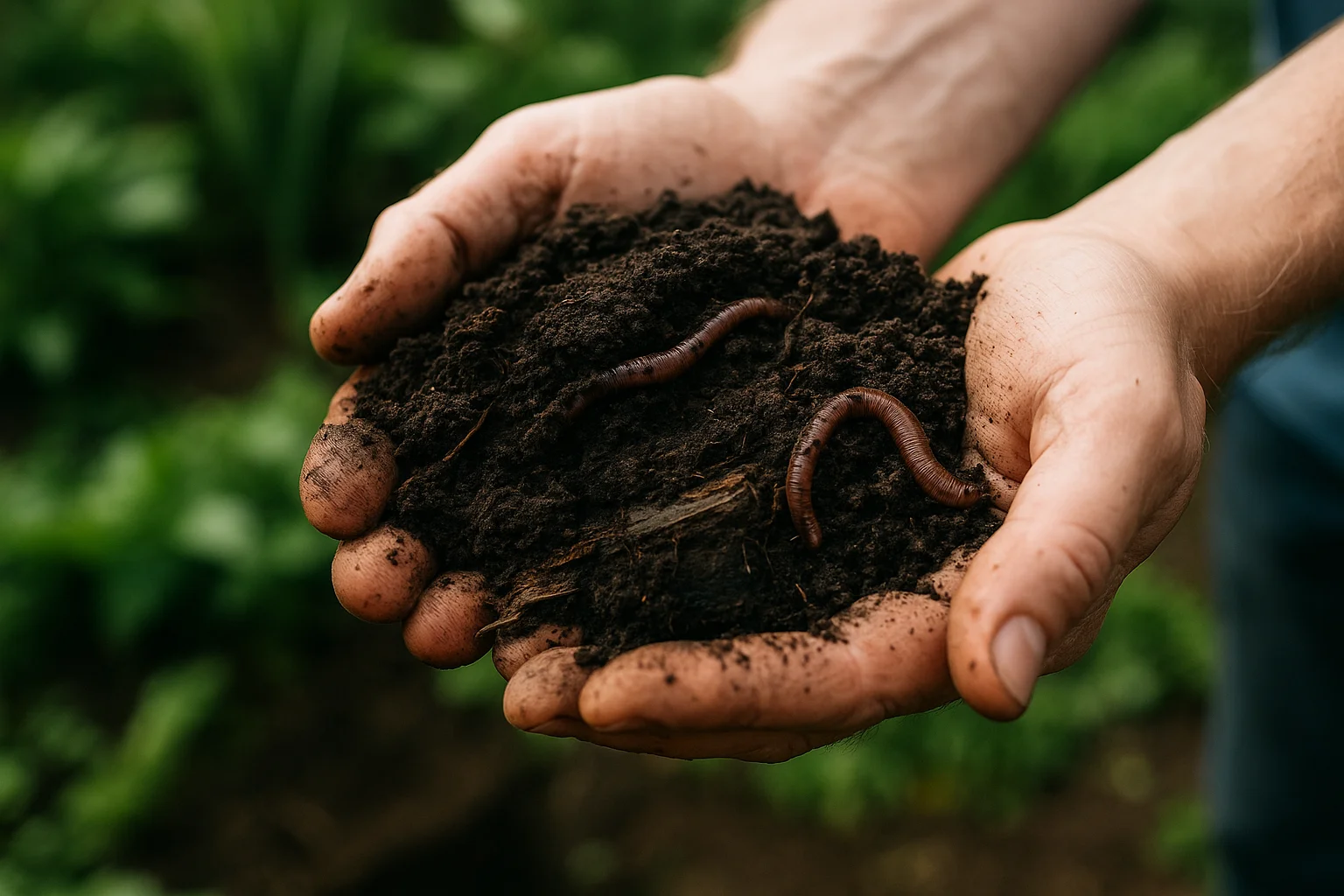
Most gardening beginners focus on seeds, beds, and watering. They ignore the soil itself. Yet the soil determines everything: whether tomatoes fruit or struggle, whether carrots grow straight or twist into knots, whether your lettuce is harvest-ready in three weeks or still looking thin after six.
Testing soil is neither expensive nor complicated. Three simple tests can be done this afternoon without buying anything. And building humus isn't an esoteric project but applied biology with measurable results.
What soil actually is
Soil isn't dead dirt. It's a living system. A single teaspoon of healthy garden soil contains more microorganisms than there are people on Earth. Fungi, bacteria, archaea, nematodes, springtails, and earthworms form a network that unlocks nutrients, stores water, and suppresses disease.
Soil consists of three mineral fractions (sand, silt, clay), organic matter (humus), water, and air. The ratio of these components determines how well your soil functions. Too sandy? Nutrients wash out. Too much clay? Waterlogging. The ideal garden soil is a sandy loam or loamy sand with 3-5% humus content.
Note
You don't need perfect soil to get started. Any soil can be improved. The tests simply show you where you stand and which direction to work in.
Jar test and spade test: know your soil in 24 hours
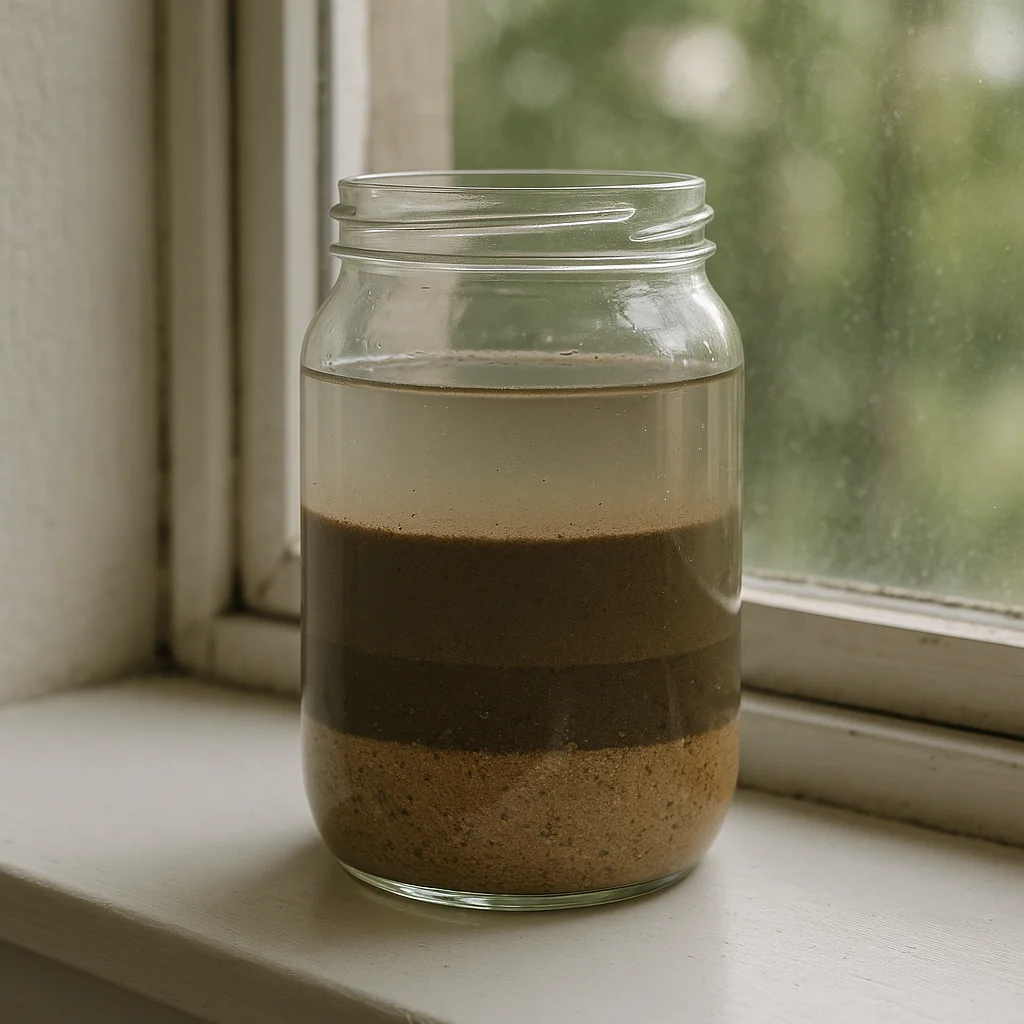
The jar test (settling test)
The simplest method to determine your soil type. You need: a large screw-top jar (1 liter), water, and a handful of soil.
- Fill with soil: Fill the jar one-third full with soil. Remove large stones and roots beforehand.
- Add water and shake: Top up with water, put the lid on, and shake vigorously for 2-3 minutes. Then set it down and don't touch it.
- Wait 24 hours: Sand settles within minutes (bottom layer). Silt takes hours (middle layer). Clay takes 24 hours and forms the top mineral layer. Organic matter floats on top.
- Read the proportions: Measure the height of each layer and calculate the percentage. Ideal garden soil: 40-60% sand, 20-40% silt, 10-20% clay.
The spade test
Dig out a cube of soil (about 30 x 30 x 30 cm) and lay it on a board or sheet. Examine the structure:
- Crumbly and loose = good structure, active soil life, roots can grow easily.
- Platy and layered = compacted soil, often caused by heavy machinery or walking on wet ground.
- Clumpy and sticky = worked too wet or too much clay content. Needs organic matter and patience.
- Earthworms visible? Good. No worms? A warning sign for lacking soil life.
pH test: the 5-euro investment that always pays off
The pH value determines which nutrients your plants can absorb. A perfectly fertilized soil is useless if the pH blocks nutrient uptake. pH test strips cost 5 euros at a pharmacy or garden center.
How to do it: mix a handful of soil with distilled water (1:1), stir, and let it sit for 15 minutes. Then dip the test strip and read it.
| pH value | Assessment | Action |
|---|---|---|
| Below 5.5 | Strongly acidic | Apply lime: 150-200 g/m2 on light, sandy soil, 300-400 g/m2 on medium to heavy soil, split over 2-3 years. Blueberries love acidic soil, vegetables don't. |
| 6.0 - 7.0 | Ideal for vegetables | Do nothing. Continue building humus. |
| 7.0 - 7.5 | Slightly alkaline | Often not a problem. Compost and mulch slowly lower pH. |
| Above 7.5 | Strongly alkaline | Work in sulfur or use conifer mulch. Iron chlorosis possible. |
Tip
Take multiple samples from different parts of the garden. pH can vary within a few meters, especially near concrete walls (alkaline) or under conifers (acidic).
When is a lab analysis worth it?
DIY tests give you a good overall picture. But for exact nutrient values (nitrogen, phosphorus, potassium, magnesium, trace elements), you need a lab. In Germany, the Agricultural Testing and Research Institutes (LUFA) in each federal state offer soil analyses for private individuals. In other countries, agricultural extension services or private labs provide similar services.
| Aspect | Details |
|---|---|
| Cost | 20-40 EUR per sample (standard: pH, P, K, Mg, humus content) |
| Frequency | Every 3-5 years is perfectly sufficient for a home garden |
| Providers | LUFA (Germany), agricultural extension services, private labs |
| What you get | Nutrient content, pH, humus percentage, individual fertilization recommendations |
| Sampling | 15-20 soil cores distributed across the area, mixed sample from 0-30 cm depth |
Remember
A lab analysis is especially worthwhile when starting fresh: when you take over a garden or break new ground. The fertilization recommendation on the result saves you money and prevents over-fertilizing.
5 levers for systematic humus building
Humus is the organic matter in soil that holds everything together: nutrient storage, water storage, habitat for soil organisms. More humus = better harvests. Here's how to build it:
- Compost: 2-3 liters per m2 per year. Mature compost is the foundation. Don't dump it all at once, apply thin layers regularly. Spring and after harvest are the best times. Compost delivers nutrients while feeding soil life simultaneously.
- Mulch: never leave soil bare. Grass clippings, straw, leaves, wood chips. Mulch protects soil from drying out, suppresses weeds, and feeds soil organisms from above. 5-10 cm layer thickness is ideal. Let grass clippings dry first, otherwise they rot.
- Cover crops: clover, phacelia, mustard. Cover crops grow on empty beds and are cut down before flowering. Clover fixes nitrogen from the air. Phacelia loosens compacted soil with deep roots. Mustard grows fast and suppresses weeds. Sow all three as a mix for maximum effect.
- Biochar / Terra Preta. Biochar has an enormous internal surface area and stores water and nutrients like a sponge. Important: never apply pure, always charge it with compost or liquid fertilizer first. Otherwise, the char initially draws nutrients from the soil. 0.5-1 liter per m2 mixed into compost.
- No-dig gardening. Every time you dig, you destroy soil structure and kill fungal networks (mycorrhiza) that feed your plants. Loosen yes, turn over no. A garden fork is enough to break up compacted spots. The no-dig method (popularized by Charles Dowding) works: compost on top, the earthworms do the rest.
Common soil management mistakes
- Too much synthetic fertilizer. Synthetic fertilizer feeds the plant but not the soil. Long-term, soil life declines. Organic fertilization (compost, manure, horn meal) is more sustainable.
- Over-fertilizing. More is not better. Too much nitrogen makes plants susceptible to pests and disease. Nitrate leaches into groundwater.
- Fresh manure directly on beds. Fresh horse or chicken manure burns roots and contains too much ammonia. Manure must compost for at least 6 months before it goes on beds.
- Leaving soil bare. Exposed soil dries out, crusts over in rain, and loses nutrients. Always mulch or sow cover crops.
- Wrong sampling technique. A single sample from one corner tells you nothing about the whole garden. Always take mixed samples from 15-20 soil cores.
Tip
Humus building takes time. Expect 3-5 years before you see a significant difference. But every measure works immediately: mulch reduces watering needs from day 1, compost delivers nutrients from the first season.
Frequently asked questions about soil testing and humus building
When is the best time for a soil test?
Autumn or early spring, before you fertilize or lime. This gives you the baseline status without distortion from recent fertilization. You'll have results in time for planting season.
Can I overdo compost?
Yes, even compost can be too much. 2-3 liters per m2 per year is a good rule of thumb. Too much compost leads to phosphate oversupply and can burden waterways. A lab analysis shows whether you already have enough phosphate in the soil.
Does biochar actually work?
Biochar stores water and nutrients and remains stable in soil for centuries. Research shows positive effects on sandy soils and acidic soils. On already good soils, the effect is smaller. Key: always charge it first (mix with compost), never apply pure.
How do I recognize good compost?
Mature compost smells like forest floor, not rot. It's dark brown to black, crumbly, and uniform. If you can still see starting materials (eggshells, twigs), it needs more time. Good compost is ready after 6-12 months.
My soil is pure clay. Is it hopeless?
No. Clay soil stores nutrients and water excellently, it just needs structure. Cover crops with deep roots (lupine, radish), plenty of compost, and mulch visibly improve clay soil over 2-3 years. Never work it when wet, that worsens compaction.