Permaculture has an image problem. Many people think of overgrown gardens, hippie romance, or endless theory. The reality: permaculture is a design system that copies ecosystems to achieve more yield with less work. Not an esoteric approach, but applied ecology.
You need neither a hectare of land nor a permaculture certificate. A normal backyard is enough. The following seven principles can be applied immediately, and most cost nothing except a shift in thinking.
What permaculture is (in 90 seconds)
Permaculture (permanent agriculture/culture) was developed in the 1970s by Bill Mollison and David Holmgren in Australia. The core idea: design systems that sustain themselves instead of constantly working against nature.
In practice, this means: observe your land, understand the natural processes (sun, wind, water, soil life), and design your garden so that these forces work for you, not against you.
The three ethical principles: care for the earth, care for people, fair share of surpluses. That sounds abstract but becomes very concrete in the seven principles below.
Note
Permaculture is a design system, not a growing method. You can apply permaculture principles to a balcony, a 200 m2 garden, or a farm. Size doesn't matter, the mindset does.
The 7 principles that work immediately
Observe before you act
Observe your garden for a full year before making big changes. Where does the sun hit in summer and winter? Where does water collect after rain? Where does the wind come from? Where does the longest morning shadow fall? This information determines where your beds go, where a tree should provide shade, and where water catchment makes sense. One year of observation saves you ten years of rebuilding.
Every element serves multiple functions
A fruit tree isn't just a food source. It provides shade for heat-sensitive crops underneath, its blossoms feed bees, its leaves become mulch, and its roots loosen the soil. For every element in your garden, ask: what three other functions can it serve? A chicken run next to the compost? The chickens turn the compost. A bench under the walnut tree? Mosquito repellent from the leaves. Multifunctionality is the opposite of monoculture.
Close the loops
In nature, there's no waste. Every output becomes input for something else. Transfer this to your garden: prunings become mulch. Kitchen scraps become compost. Rainwater gets collected. Harvest residues return to the soil. Whenever you dispose of something, ask: can I keep this in the system? The more closed your loops, the less you need to buy from outside.
Plan in zones
Arrange elements by frequency of use. What you need daily (herbs, salad greens) goes right next to the house. What needs weekly care (vegetables) goes a bit further out. Low-maintenance elements (fruit trees) further still. And a corner stays wild for beneficial insects and wildlife. This saves you walking distance and time every single day.
Feed the soil, not the plant
In conventional gardens, you feed the plant directly with synthetic fertilizer. In permaculture, you feed the soil. Mulch, compost, and cover crops nourish soil organisms, which in turn feed the plants. The result: a self-reinforcing cycle that improves every year. Don't dig, mulch it, and the soil life does the rest.
Diversity over monoculture
Monoculture is vulnerable. When aphids arrive and you only have lettuce, you lose everything. Companion planting stabilizes: tomatoes next to basil (confuses whitefly), beans next to corn (nitrogen for the corn), calendula among vegetables (attracting pollinators). Build guilds: plant communities that support each other like in a natural ecosystem.
Maximize edges
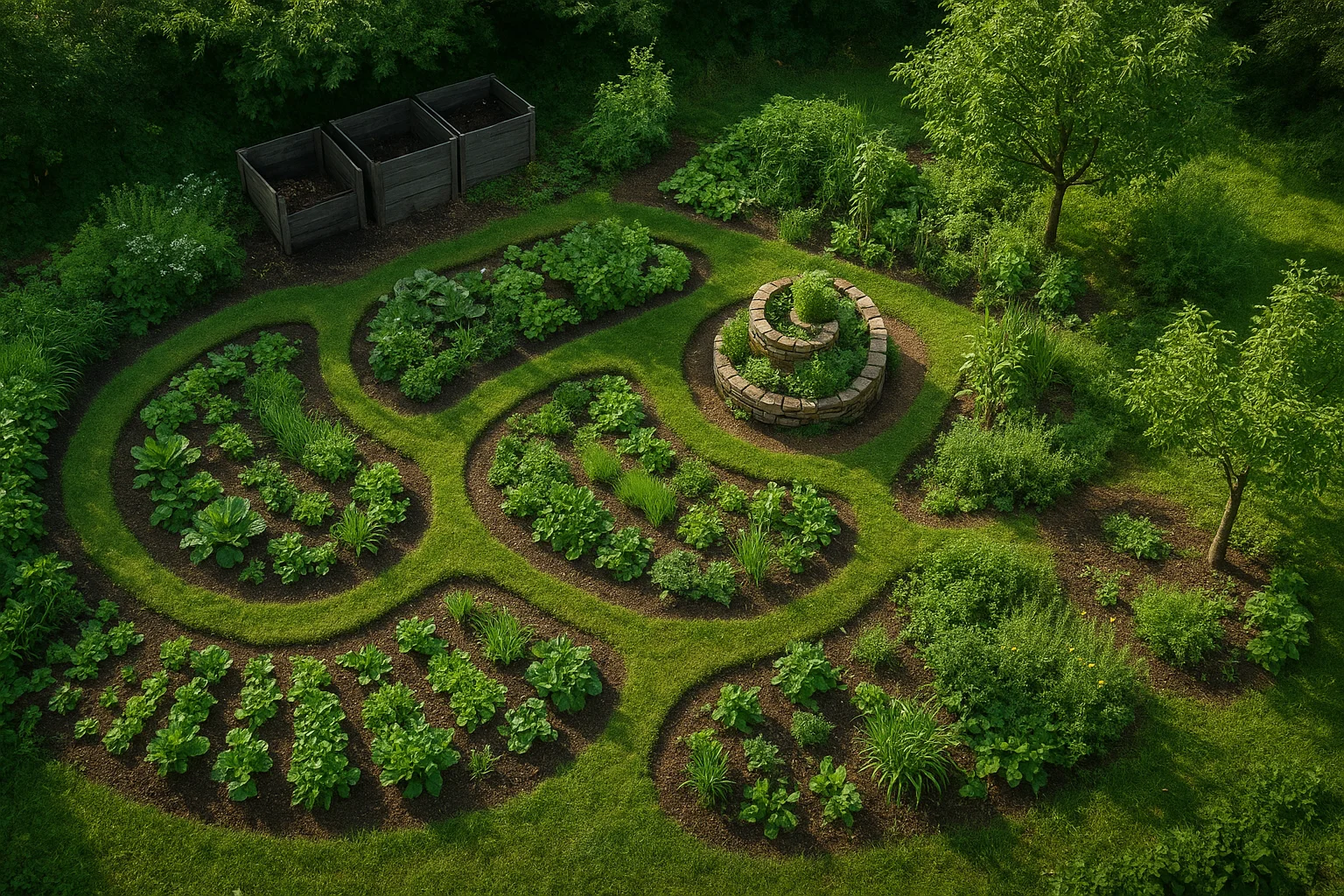
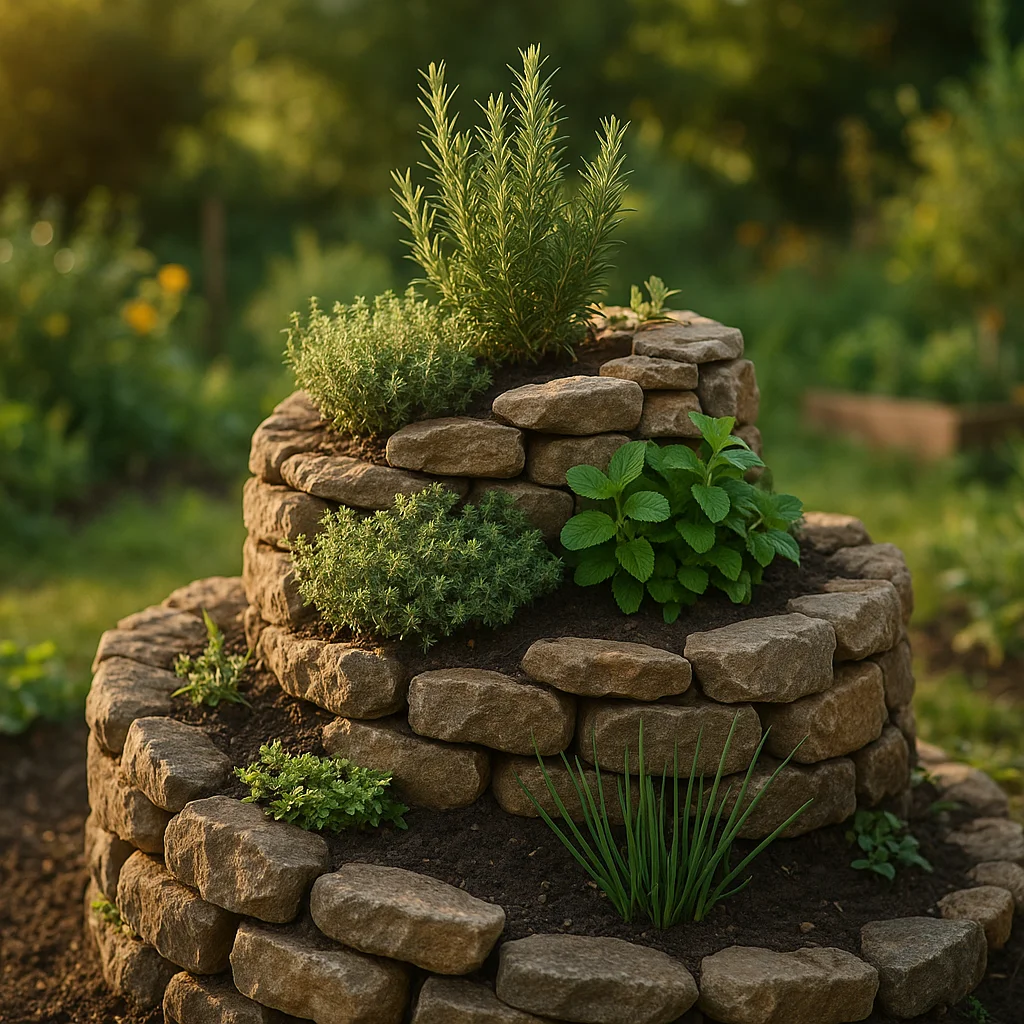
In nature, the most action happens at edges: forest margins, shorelines, hedge borders. Where two ecosystems meet, biodiversity explodes. Apply this to your garden: curved bed edges instead of straight rows increase the edge zone. Keyhole beds offer maximum edge length on minimum area. An herb spiral uses three-dimensional space. Irregular pond edges create habitat for amphibians and insects.
Zone planning for a 200 m2 backyard
On 200 m2, you can implement a surprisingly complete permaculture system. Here's an example of how to divide the zones:
| Zone | Area | Contents | Maintenance |
|---|---|---|---|
| Zone 0 | House | Kitchen, sprouting, windowsill herbs | Daily |
| Zone 1 | 10-20 m2 | Herb spiral, salad greens, cut-and-come-again lettuce, chives | Daily |
| Zone 2A | 40-60 m2 | Intensive vegetables: tomatoes, peppers, eggplant, cucumber | Every 2-3 days |
| Zone 2B | 30-40 m2 | Robust vegetables: potatoes, squash, beans, cabbage | Weekly |
| Zone 3 | 20 m2 | Compost, storage, tools, rainwater tank | As needed |
| Zone 4 | 30-40 m2 | Fruit trees, berry bushes, nut trees | Seasonal |
| Zone 5 | 10-20 m2 | Wild corner: deadwood pile, wildflower meadow, pond | Minimal |
Tip
Zones don't have to be concentric circles. Adapt them to the shape of your property, sun exposure, and access points. Zone 1 can also be a narrow strip right next to the kitchen door.
Water management is a cross-cutting theme across all zones: collect rainwater from the roof in barrels. Mulch on all beds reduces soil evaporation significantly, by 33 to 60% across studies depending on mulch type and depth. Swales on slopes catch rainwater and direct it into the soil. A small pond in Zone 5 stores water and creates habitat for frogs and dragonflies that eat pests.
What permaculture is not
Let's clear up the most common misconceptions:
- Not letting things go wild. Permaculture is intensive design, not doing nothing. A permaculture garden looks different from a conventional one, but it's planned and maintained.
- Not anti-technology. Permaculture uses technology where it makes sense. Rainwater pumps, greenhouses, even drip irrigation. It's about smart use, not abstinence.
- Not "just plant a forest." Food forests are one tool in permaculture, but not the only one. Annual vegetables have their place just as much as perennial systems.
- Not instant results. Permaculture systems need 3-5 years to hit their stride. The first years are an investment. But from then on, effort decreases while yield increases.
Remember
Permaculture isn't all-or-nothing. You can adopt a single principle (e.g., mulching) and skip the rest. Every applied principle improves your system, even without redesigning the whole garden.
Recommended books
If you want to go deeper, these books are a solid starting point:
- Toby Hemenway: "Gaia's Garden". The best entry point for backyard gardeners. Focused on small spaces and temperate climates.
- David Holmgren: "Permaculture: Principles and Pathways Beyond Sustainability". The theoretical foundation. Demanding but fundamental.
- Sepp Holzer: "Sepp Holzer's Permaculture". A practical book from an Austrian mountain farmer implementing permaculture in alpine climate. Many concrete techniques.
- Charles Dowding: "No Dig". Not explicitly permaculture, but the best guide for soil-building gardening that fits perfectly into any permaculture system.
Frequently asked questions about permaculture in the backyard
Do I need a permaculture certificate?
No. A PDC (Permaculture Design Certificate) is excellent continuing education, but not necessary for a backyard garden. The principles in this article are enough to get started. Learning by doing is explicitly encouraged in permaculture.
Does permaculture work in temperate climates or is it only for warm regions?
Permaculture works everywhere because it's a design system, not a growing method. The specific plants and techniques adapt to the climate. In temperate zones, you use winter vegetables, cold-hardy fruit trees, and season extension instead of tropical fruits.
Is permaculture more work than conventional gardening?
In the beginning, yes, because you plan and observe more. After 2-3 years, less, because the systems self-regulate. Mulch suppresses weeds, companion planting reduces pests, and healthy soil needs less fertilizer. Long-term, you save significant effort.
What is a keyhole bed?
A round bed with a wedge-shaped access path that looks like a keyhole from above. You can reach all areas from the center without stepping on the bed. The round shape maximizes bed area relative to path space and provides a long edge zone where growing is particularly productive.
Can I do permaculture on a balcony?
Yes. Permaculture principles apply regardless of space. On a balcony that means: close loops (worm bin for kitchen scraps), diversity (mix herbs, tomatoes, flowers), use edges (plant railings), and observe (sun, wind, microclimate).