TL;DR
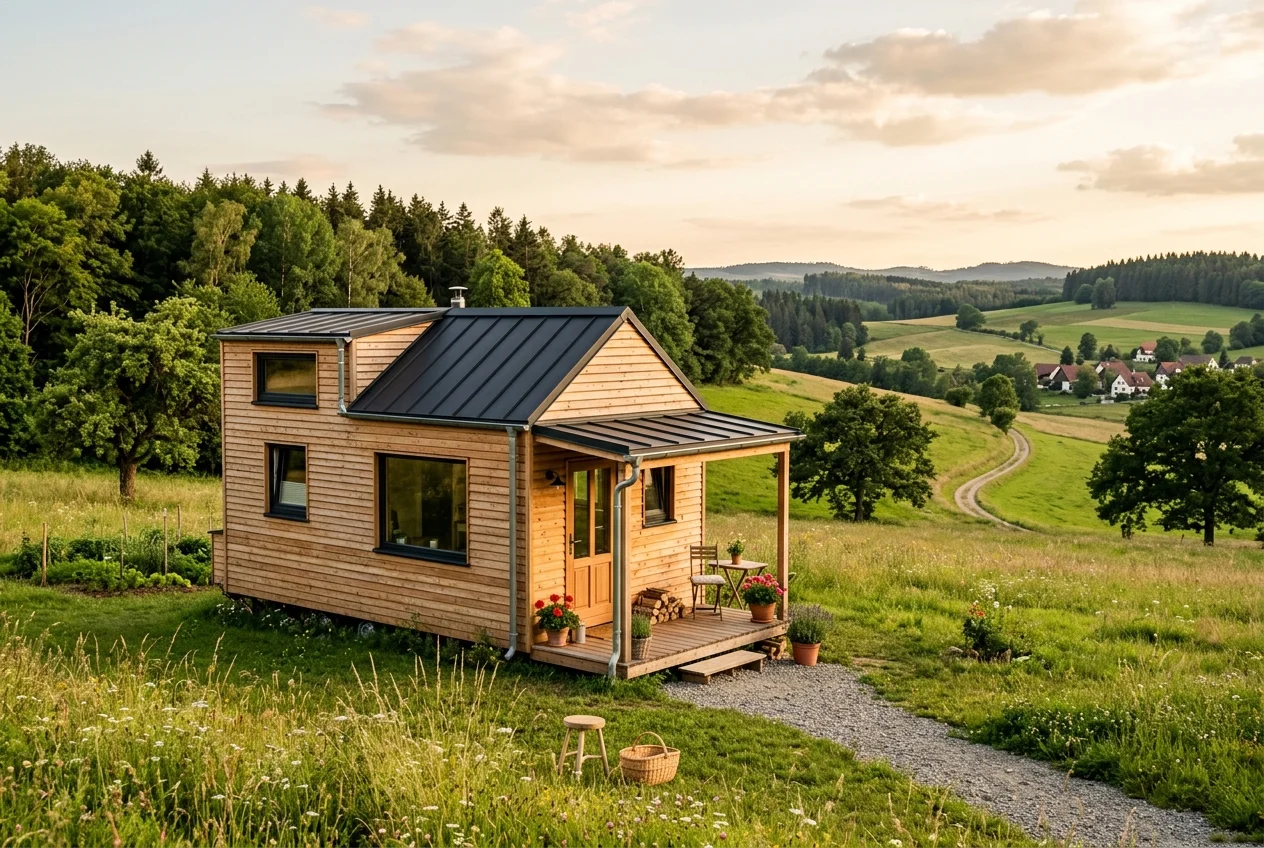
A tiny house on wheels is not a vehicle under German building law, it's usually a structure in "Gebäudeklasse 1," and the Oberverwaltungsgericht Berlin-Brandenburg upheld a usage ban against a registered trailer-based tiny house in 2023. What actually decides whether you can live there permanently is usually the land-use zoning, not the house's floor area. In parallel, the research on decluttering paints a more honest picture than the often-repeated claim that "science proves tidying makes you happier": there's real, but thin and partly contradictory evidence, not a large controlled trial of the KonMari method itself.
Two promises carry a large part of the voluntary simplicity movement: the small house that frees you from building codes and mortgages, and the decluttered home that scientifically proven-ly makes you happier. Both promises are catchy, visual, and popular in marketing. Both only partly survive close scrutiny.
This article checks two very concrete, very different claims from two different corners of voluntary simplicity. First: what German building law actually does with a tiny house, beyond the glossy pictures of houses on wheels that supposedly escape the permit process. Second: what peer-reviewed research on decluttering actually shows, beyond the line "studies prove that tidying makes you happier," repeated unsourced in nearly every minimalism guide. Both are versions of the same question: where does the physical simplification of living space end, and where does a mental practice begin that research has only started to understand?
What a tiny house actually is under building law
Tiny house marketing likes a simple equation: small plus wheels equals free from building regulation. German building law doesn't recognize that equation. What matters isn't the house's size, and usually not whether it has wheels, but which "Gebäudeklasse" (building class) it falls into.
Most tiny houses land in Gebäudeklasse 1: a freestanding building up to 7 meters in height, with no more than two usage units totaling no more than 400 square meters. A tiny house of 20 or 30 square meters clears these criteria easily. It's exactly this classification, not the house's actual size, that triggers the general building-code regime. Bavaria's state building code (BayBO) states it in nearly identical language:
| Criterion | Gebäudeklasse 1 (Art. 2 Abs. 3 Nr. 1 BayBO) |
|---|---|
| Building type | Freestanding building |
| Height | Up to 7 meters |
| Usage units | No more than two |
| Total usage-unit area | No more than 400 m² |
For most tiny house owners, this classification changes little about the day-to-day living experience, but a lot about the legal starting point: a tiny house becomes an entirely ordinary building under building law, just a very small one. It's generally subject to the same core principles as a single-family house, not a separate, looser category for micro-housing.
Note on the source
Art. 2 Abs. 3 Nr. 1 BayBO is Bavarian state law. The Gebäudeklasse 1 definition is very similar in substance across other German states' building codes, since they're all based on the model building code (Musterbauordnung), but exact wording and detail rules can differ. Building law is a state, not a federal, competence in Germany. Anyone building in a different state should check that state's own building code, not treat Bavaria's as a blueprint.
"Wheels make it a vehicle": what a court actually said
Probably the most persistent myth in tiny house marketing is that a house on a registered trailer is a vehicle, not a building, and therefore doesn't need a building permit. That idea has faced a real-world test, and it didn't survive it.
The Oberverwaltungsgericht Berlin-Brandenburg ruled in 2023 (10th Senate, case OVG 10 S 15/23, decision of 22 June 2023) on a tiny house on a registered vehicle trailer and upheld an official usage ban. The court's central line leaves little room for interpretation:
"Nach ständiger Rechtsprechung können auch zugelassene Fahrzeuge... bauliche Anlagen im Sinne des § 2 Abs. 1 Satz 1 BbgBO sein."
Translated: an official vehicle registration doesn't automatically shield a structure from being classified as a building. What matters isn't the license plate, but how the thing is actually used, a tiny house that sits permanently in one place, is lived in, and isn't regularly moved, functions like a building regardless of whether it sits on wheels or a foundation. The Brandenburg building code (BbgBO) the court cites isn't an outlier here; it follows the same underlying logic as most other state building codes.
What this means in practice
A tiny house on wheels that's lived in permanently and not regularly moved can be treated as a fixed building under building law, despite carrying a vehicle registration. Anyone planning to live in a tiny house permanently shouldn't rely on wheels as a legal loophole, clear the intended use with the local building authority (Bauamt) from the start, the way you would for a stationary building.
A surprisingly favorable exception: ceiling height
Not every detail rule works against the tiny house. Under Art. 45 BayBO, occupied rooms in Bavaria generally need a clear ceiling height of at least 2.40 meters, with 2.20 meters allowed in attic rooms where that height is maintained over more than half the usable floor area. At first glance, that sounds like another obstacle for a house where every centimeter counts.
But the decisive sentence sits in the same article, easy to miss in the fine print: this height requirement explicitly does not apply to occupied rooms in residential buildings of Gebäudeklasse 1 and 2, precisely the class most tiny houses fall into. The one rule most likely to become a problem for a very small house turns out not to apply to the typical tiny house situation at all.
Counterintuitive, but documented
The ceiling-height exemption for Gebäudeklasse 1 and 2 is one of the few places where German building code genuinely works in the tiny house's favor instead of against it. As with the rest, though: this is Bavarian law, and details can differ by state.
What actually decides permanent residence: not the floor area
A widespread misconception holds that there's a statutory minimum living area below which a dwelling can't legally exist. Based on the available sources, German state building codes don't prescribe a minimum floor area for a dwelling. Whether a tiny house is permitted as a primary residence depends mainly not on its square meterage, but on the land-use zoning of the property: if the plot is designated under a Bebauungsplan (development plan) as, say, a Kleinsiedlungsgebiet, Wohngebiet, or Dorfgebiet, permanent residence is generally possible there. Without that designation, an otherwise building-code-compliant tiny house doesn't help.
Whether a building permit is required at all, and via which procedure, is again handled differently by each state's building code, also a matter of state, not federal, competence.
A note on this source
The claims about the missing minimum floor area and the importance of zoning come from a commercial advisory portal (wohnglueck.de), not directly from statutory text. They're plausible and consistent with the general structure of German building law, but weren't independently verified against the primary text of every state building code for this article. This article is general information, not building-law advice. Anyone planning to live in a tiny house permanently should contact the local Bauamt and check the specific zoning and their state's building code before buying land or a structure.
From physical to mental simplification: what the decluttering research shows
A tiny house simplifies physical living space. The second half of the voluntary simplicity movement, led by the success of the KonMari method, promises a mental parallel: less stuff, more wellbeing. The line "science proves decluttering makes you happier" shows up in countless minimalism articles. What the actual, peer-reviewed research shows is considerably more cautious, and at points contradictory.
Tidy beats messy, for one specific kind of task
A controlled lab study by Mateo, Hernández, Jaca, and Blazsek (2013), published in Management Decision, had participants complete a data-entry-style task in either a tidy or a messy work environment. Result: conscientious participants made significantly more errors in the messy environment than in the tidy one. That's a real, controlled finding, but for a very specific kind of task (accuracy on repetitive, rule-based work), not for life satisfaction in general.
And then the opposite: mess as a creativity engine
The same year, Vohs, Redden, and Rahinel (2013) published a set of experiments in Psychological Science with an opposing finding: messy environments were associated with more creative, novel outputs on some tasks, while tidy environments correlated more with conventional, rule-following behavior. The Association for Psychological Science summed it up plainly in its official press release: tidy desk or messy desk, each has its benefits.
Which means the two most-cited lab studies from the same year contradict each other's core takeaway, depending on which kind of performance you measure. Both say something about task execution, neither says anything direct about KonMari or general wellbeing.
| Study | Environment | Finding |
|---|---|---|
| Mateo et al. 2013, Management Decision | Tidy vs. messy | Tidy: fewer errors for conscientious individuals (data-entry task) |
| Vohs, Redden & Rahinel 2013, Psychological Science | Tidy vs. messy | Messy: more creative, novel outputs on some sub-tasks |
Why "self-efficacy" might be the real lever, not tidiness itself
Chris Stiff, a psychology lecturer at Keele University, assessed the KonMari method in a 2019 piece for The Conversation. His argument: the psychological benefit of decluttering is probably tied more to "self-efficacy," the feeling of having successfully completed a difficult task, than to tidiness itself. But that argument cuts both ways, Stiff also cites research showing that people who abandon a task partway through typically perform worse afterward and engage in "unhealthy self-blame."
Applied practically, that means a KonMari attempt started but not finished could plausibly backfire rather than help, a detail missing from most "declutter now, get happy" guides.
The one study that actually looks at KonMari itself
The closest thing to a direct test of the KonMari method comes from Muster, Iran, and Münsch (2022), published 26 August 2022 in Frontiers in Sustainability under the title "Spark Joy and Slow Consumption: An Empirical Study of the Impact of the KonMari Method on Acquisition and Wellbeing." It's a German citizen-science study with 426 participants, described by its own authors as an early empirical study specifically on the KonMari method.
The core findings:
- Main motive was psychological relief, not environmental concern: participants' most commonly cited motivation for decluttering was psychological relief and reduced stress, not environmental awareness.
- Relationships, experiences, and health beat material acquisition: when ranking future life priorities, participants placed relationships (25%), experiences (22%), and health (19%) above material possessions.
- The rebound effect stays explicitly unresolved: the study can't rule out that the newly gained space stimulates additional consumption, in the authors' own words, "the newly gained space will stimulate additional consumption" remains a live possibility the data don't disprove.
How solid is this study?
The sample was self-selected, not random: roughly 70% of participants were women, 59% were aged 51 to 70, and 70% held a university degree. That's a plausible profile for people who voluntarily join a decluttering study, but not a representative cross-section of the population. The authors themselves flag the open rebound-consumption question as unresolved, not as a footnote.
The honest conclusion: real, but thin, evidence
Taken together, the picture is considerably more cautious than the line that circulates in minimalism circles. There's genuine, peer-reviewed research on tidiness, environment, and wellbeing. But there's still no large randomized controlled trial that tests Marie Kondo's specific KonMari method against a control group and measures durable wellbeing outcomes. The lab literature on tidy versus messy environments (Mateo et al., Vohs et al.) studies task performance and creativity, not KonMari itself, and the two most-cited studies from the same year point in different directions. The most direct KonMari study to date (Muster et al. 2022) is a small, self-selected citizen-science survey whose own authors leave the central open question, rebound consumption, unresolved.
None of that means decluttering doesn't work. It means "science proves decluttering makes you happier" overstates a real but thin and partly contradictory body of evidence, a more honest summary would be: some real, mixed, and limited evidence, not proof.
Two forms of the same simplification
The tiny house and the decluttered home represent the same basic idea at two different levels. The tiny house simplifies the physical space you live in, and runs into a real, often underestimated web of Gebäudeklassen, land-use zoning, and state law that has little to do with the image of a free, regulation-free life on wheels. Decluttering with KonMari simplifies your mental relationship to possessions, and runs into a body of research that's real, but noticeably thinner than the marketing promises suggest.
Both are still worth pursuing, for the same sober reasons: a smaller house genuinely costs less to build and maintain, if you clear the legal groundwork first instead of relying on myths; a decluttered home genuinely feels more pleasant to most people, even though science doesn't (yet) offer one large, clean proof of lasting happiness. The honest version of both promises is more modest than the sold version, but no less worthwhile for it.
Frequently asked questions about tiny houses and decluttering research
Does a tiny house on wheels really need a building permit?
In many cases, yes. The Oberverwaltungsgericht Berlin-Brandenburg confirmed in 2023 that even registered vehicles can count as building structures under building law when they sit permanently in one place and are lived in. Vehicle registration alone doesn't shield a structure from building law. Whether a permit is required in a specific case depends on the relevant state building code.
Is there a legal minimum size for a dwelling in Germany?
Based on available sources, German state building codes don't prescribe a minimum floor area for a dwelling. What usually matters more is the land-use zoning of the property. This claim comes from a secondary source and should be verified with the local Bauamt.
Does science really prove that decluttering makes you happier?
No, that overstates the evidence. There's real, but limited and partly contradictory, peer-reviewed research, and no large randomized controlled trial of the KonMari method itself against a control group.
Can an abandoned decluttering project backfire?
That's plausible. Psychologist Chris Stiff points to research showing that people who abandon a task instead of finishing it tend to perform worse afterward and engage in unhealthy self-blame. A half-finished KonMari attempt could plausibly add stress rather than relieve it.
Why does the ceiling-height exemption matter for tiny houses?
Under Art. 45 BayBO, residential buildings of Gebäudeklasse 1 and 2, the typical tiny house class, are explicitly exempt from the usual minimum ceiling height. It's one of the rare rules that genuinely favors small houses instead of complicating them, though it's Bavarian state law.
Sources
- Art. 2 Abs. 3 Nr. 1 BayBO, building classes, gesetze-bayern.de, accessed 2026-08-19
- OVG Berlin-Brandenburg, decision of 22 June 2023, case OVG 10 S 15/23, Gerichtsentscheidungen Brandenburg, accessed 2026-08-19
- Art. 45 BayBO, occupied rooms, gesetze-bayern.de, accessed 2026-08-19
- "Baugenehmigung fürs Tiny House", wohnglueck.de, secondary source, accessed 2026-08-19
- Mateo, Hernández, Jaca & Blazsek, "Effects of tidy/messy work environment on human accuracy", Management Decision, Vol. 51, No. 9, 2013, accessed 2026-08-19
- "Tidy Desk or Messy Desk? Each Has Its Benefits" (on Vohs, Redden & Rahinel, Psychological Science, 2013), Association for Psychological Science, accessed 2026-08-19
- Chris Stiff, "Marie Kondo: a psychologist assesses the KonMari method of tidying", The Conversation, 2019, accessed 2026-08-19
- Muster, Iran & Münsch, "Spark Joy and Slow Consumption: An Empirical Study of the Impact of the KonMari Method on Acquisition and Wellbeing", Frontiers in Sustainability, published 2022-08-26, accessed 2026-08-19
This content was created with AI assistance, primarily for research and drafting. Reviewed and approved by our editorial team.